Introduction
When a pressure transmitter fails at -40°F on an offshore platform or a control valve enclosure corrodes through in a coastal refinery, the consequences extend far beyond a simple maintenance call. In oil and gas, petrochemical, and power generation facilities, unplanned downtime from instrument failure costs between $100,000 and $1 million per hour, with mid-size refineries losing $20 million to $50 million annually to reliability issues.
Extreme weather—sub-zero cold, corrosive salt spray, explosive atmospheres, and ice-laden wind—demands far more than basic weatherproofing. Standard electrical enclosures may keep water out, but they won't hold internal temperatures above freezing at -60°F ambient, resist corrosion in H2S-laden atmospheres, or satisfy hazardous area classifications for Zone 1 or Class I Division 1 locations.
The gap between "weatherproof" and "rated for extreme conditions" is where instrument failures actually happen.
The 10 manufacturers below were evaluated on certifications, thermal management systems, hazardous area compliance, and installation practicality — the criteria that matter when conditions go beyond what a standard spec sheet covers.
Key Takeaways
- Outdoor instrument enclosures require IP65/IP66 or NEMA 4X minimum for extreme weather
- Key differentiators: heated liner technology, hazardous area ratings (ATEX/IECEx/NEC Class I Div 1/2), heater longevity, and modular design
- Terrapin Industrial's patented retrofittable design installs around live instruments without taking them offline
- Evaluate by thermal range, installation cost, maintenance access, and required site certifications
- Primary sectors: oil and gas, petrochemical, mining, marine/offshore, and chemical manufacturing
What Sets Outdoor Industrial Instrument Enclosures Apart
Industrial instrument enclosures protect transmitters, analyzers, and control valves in live process environments where taking equipment offline costs thousands per hour. They're purpose-built for process duty — accommodating tubing, manifold access, and local display visibility while withstanding direct chemical exposure. General electrical junction boxes aren't designed for this.
Weatherproofing is the baseline. The real differentiators are:
- Keeping internal temperatures above -40°C minimums during arctic operations through active heating and insulation
- Resisting salt spray, hydrogen sulfide, and airborne corrosives common in offshore and refinery environments
- Carrying explosion-proof or intrinsically safe ratings for Zone 1/2 and Division 1/2 hazardous area classifications
- Supporting fast field installation without requiring process shutdowns or offsite integration
The manufacturers below have earned their place on this list by meeting these criteria across the harshest operating environments — arctic pipelines, offshore platforms, and petrochemical facilities where enclosure failure triggers safety incidents, not just work orders.
Top 10 Outdoor Industrial Instrument Enclosure Manufacturers for Extreme Weather
These manufacturers were evaluated across four criteria: weather protection ratings, thermal management capability, hazardous area certifications, and real-world installation practicality. Each entry includes key specs and certifications relevant to extreme outdoor environments.
Terrapin Industrial
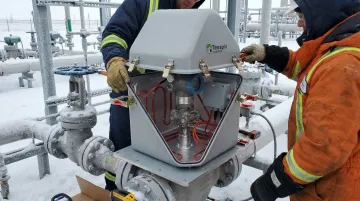
Terrapin Industrial is a Texas-based innovator founded by oil and gas field professionals who identified critical inefficiencies in traditional rigid enclosure installations. The company's ThermaGuard product line includes both a retrofittable IP66-rated enclosure and an expandable IP65-rated enclosure, both featuring a patent-pending heated liner system.
Several features set Terrapin apart for extreme weather applications:
- Modular quick-connect design installs around existing instruments without taking them offline
- Heated liner maintains >75°F (23.9°C) internal temperature in -60°F (-51.1°C) ambient environments
- Heater cable carries a 30-year life expectancy versus 5 years for traditional finned heaters
- Installation time reduced by approximately 60%, with total installed cost reduction of 30%
- Individual parts are replaceable, eliminating complete enclosure swaps for component failures
| Category | Details |
|---|---|
| Key Certifications | IP66 (Retrofittable Enclosure), IP65 (Expandable Enclosure); heated liner rated for T6 hazardous areas |
| Thermal Performance | Maintains >75°F/23.9°C in -60°F/-51.1°C ambient; heat output 108–720 watts depending on heater cable selection |
| Installation Advantage | Installs in under 2 minutes; no offline downtime required; reduces total installation cost by ~30%; parts individually replaceable |
nVent Hoffman
nVent Hoffman is a global leader with decades of experience supplying enclosures for energy, automation, and telecommunications. Their ZonEx series and Extreme Environments portfolio target harsh outdoor industrial applications.
Standout features for extreme weather include:
- UL Type 4X and IEC IP66/IP69K certifications across key product lines
- Stainless steel (304/316L) and fiberglass construction options for corrosion resistance
- Integrated heater and thermostat packages for thermal management
- Adhesive-free gasketing designed to withstand corrosives and broad temperature swings
| Category | Details |
|---|---|
| Key Certifications | UL Type 4X, IEC IP66, IP69, IP69K; ZonEx series meets ATEX Directive 2014/35/EU and IECEx for Zone 1/2 |
| Notable Feature | Integrated heater/thermostat packages; stainless steel and fiberglass material options for corrosion resistance |
| Industries Served | Oil and gas, utilities, industrial automation, and infrastructure |
Rittal
Rittal is one of the world's largest enclosure manufacturers, headquartered in Germany, with a comprehensive catalog including outdoor industrial enclosures with integrated climate control systems. The VX SE free-standing system and TS 8 baying systems offer high protection levels for extreme environments.
Rittal's strength lies in its thermal management ecosystem—enclosure heaters, air-air heat exchangers, and thermostat-controlled systems—combined with stainless steel (304/316L) and polyester enclosure series rated to IP66 and NEMA 4X standards.
| Category | Details |
|---|---|
| Key Certifications | NEMA 4X, IP66 ratings; IECEx/ATEX listings available in outdoor enclosure range |
| Thermal Management | Integrated climate control accessories including heaters, thermoelectric coolers, and thermostat-controlled systems |
| Industries Served | Industrial automation, energy, IT infrastructure, and petrochemical |
R. Stahl
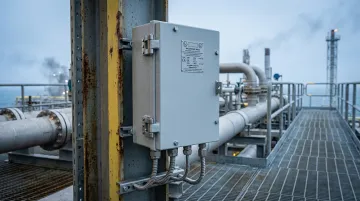
R. Stahl is a German manufacturer specializing in explosion-protected equipment and enclosures for hazardous areas, widely used in oil and gas refineries, chemical plants, and offshore platforms. The company focuses on Ex e (increased safety) terminal boxes and empty enclosures certified for ATEX and IECEx zones.
Stahl enclosures are engineered specifically for Zone 1/2 and Division 1/2 hazardous locations in extreme environments, with strong emphasis on Glass-Fibre-Reinforced Polyester (GRP) and stainless steel (1.4404) construction for corrosion resistance and lightweight durability.
| Category | Details |
|---|---|
| Key Certifications | ATEX, IECEx certifications for Zones 1, 2, 21, and 22; NEC Class I Div 1/2 ratings |
| Construction | GRP (glass-fibre-reinforced polyester) and stainless steel; IP-rated for outdoor hazardous areas |
| Primary Use Case | Hazardous area instrument protection in oil refining, chemical manufacturing, and offshore environments |
Hammond Manufacturing
Founded in 1917 and headquartered in Guelph, Ontario, Hammond Manufacturing brings over a century of experience supplying enclosures across North America. Their extensive range includes the 1414 NEMA 4X series and PJ Series polyester junction boxes designed for field instrument protection.
Hammond offers NEMA 4 and 4X rated outdoor enclosures in steel, stainless steel (304/316L), aluminum, polycarbonate, and fiberglass-reinforced polyester. Climate control solutions include heaters and thermostats for cold weather applications.
| Category | Details |
|---|---|
| Key Certifications | NEMA 4, NEMA 4X, and applicable UL listings for outdoor enclosure product lines |
| Material Options | Carbon steel, 304/316 stainless steel, aluminum, polycarbonate, fiberglass reinforced polyester; UV and corrosion resistant |
| Industries Served | Electronics, electrical, data communications, and industrial automation |
Pepperl+Fuchs
Pepperl+Fuchs is a German automation company known for sensors and field devices, with a specialized line of field instrument housing and junction box enclosures for harsh and hazardous process environments. The SR Series (stainless steel) and GR Series (GRP) are designed specifically for hazardous areas.
These enclosures offer IP66 protection and are certified Ex e (increased safety) with an extended temperature range of -60°C to +90°C, making them well-suited for extreme climates. Construction uses AISI 316L stainless steel with brushed finish for durability.
| Category | Details |
|---|---|
| Key Certifications | ATEX, IECEx, and applicable IP66 ratings for field instrument enclosure products |
| Design Focus | Extended temperature range (-60°C to +90°C); AISI 316L stainless steel construction |
| Industries Served | Oil and gas, chemical processing, and industrial automation |
Bartec
Bartec is a German specialist in explosion-protected technology for hazardous locations, with enclosures used in petrochemical, pharmaceutical, and energy industries worldwide. The company focuses on extreme environment performance including low-temperature operation and salt atmosphere resistance.
Bartec solutions align with IECEx schemes for global compliance and specialize in equipment suitable for T6 temperature class applications (max surface temp 85°C), critical for gases with low auto-ignition temperatures.
| Category | Details |
|---|---|
| Key Certifications | ATEX Zone 1/2, IECEx, and NEC Division certifications for instrument enclosure range |
| Construction | Aluminum alloy, GRP, and stainless steel; IP-rated for outdoor extreme weather models |
| Primary Use Case | Hazardous area instrument protection in petrochemical, pharmaceutical, and energy sectors |
Intertec
Intertec specializes in analytical and instrumentation enclosures for process industries, with products engineered for field-mounted instruments in extreme climates. The MULTIBOX and DIABOX enclosures, along with larger cabinets and shelters, are fabricated from high-performance Glass Fibre Reinforced Polyester (GRP).
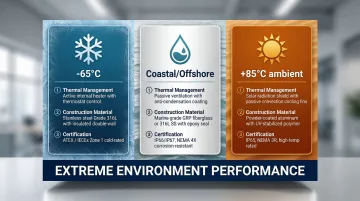
Intertec's core differentiator is temperature-controlled instrument shelters designed for environments ranging from arctic cold (down to -65°C) to desert heat. Solutions use "sandwich" construction with PU-foam cores for superior insulation.
| Category | Details |
|---|---|
| Key Certifications | IECEx, ATEX, and CSA Type 4X certifications |
| Thermal Management | Integrated heating and cooling; arctic (-65°C) to desert environment ratings with PU-foam insulation |
| Industries Served | Oil and gas, petrochemical, water/wastewater, and power generation |
APX Enclosures
APX Enclosures is a US-based manufacturer known for custom and standard NEMA-rated enclosures used in electrical, electronic, and industrial applications for outdoor environments. The company offers NEMA 4X enclosures including large single-door and "Specline" models with extensive customization capabilities.
Construction materials include 5052-H32 aluminum, 304 stainless steel, and carbon steel. Customization options encompass electrical integration, mounting, insulation, and fan kits for site-specific installations.
| Category | Details |
|---|---|
| Key Certifications | NEMA 4, NEMA 4X, and UL listings applicable to outdoor enclosure products |
| Customization | Custom fabrication options including cutouts, mounting, materials, and finishes for site-specific installations |
| Industries Served | Transportation, security systems, power distribution, and industrial automation |
NEMA Enclosures Manufacturing Corp
Based in Houston, Texas, NEMA Enclosures Manufacturing Corp specializes in custom and standard NEMA-rated electrical enclosures engineered to withstand outdoor industrial weather exposure. Their range includes wall-mounted, freestanding, and custom enclosures meeting NEMA 4 and 4X standards.
Products are constructed from stainless steel, aluminum, and carbon steel with finish options for corrosion resistance. Customization options include silk-screening, passivation, and electro-polishing.
| Category | Details |
|---|---|
| Key Certifications | NEMA Type 4, 4X, and IP equivalencies applicable to outdoor product line |
| Construction | Carbon steel, stainless steel, aluminum with corrosion-resistant finish options |
| Industries Served | Oil and gas, industrial automation, and general outdoor electrical applications |
How We Selected These Manufacturers
We assessed manufacturers on their ability to protect instruments in genuinely extreme conditions—sub-zero temperatures, corrosive or marine atmospheres, hazardous area classifications, and high-wind/rain/ice environments—not just general outdoor weatherproofing.
Key evaluation criteria:
- IP and NEMA protection ratings: IP65/IP66 minimum for dust and water jet protection; NEMA 4X for corrosion and ice resistance
- Active thermal management: Availability of heated enclosures, insulated liners, and verified temperature operating ranges
- Hazardous area certifications: ATEX, IECEx, NEC Class I Div 1/2 compliance for explosive atmospheres
- Live replacement capability: Whether designs support field installation, live replacement, or require process shutdown
- Track record: Proven deployments in demanding sectors like oil and gas, marine, and chemical processing
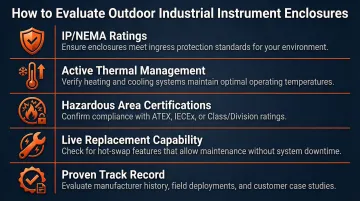
Selecting on IP/NEMA ratings alone is the most common mistake buyers make. Without verifying thermal performance range, heater longevity, hazardous area compliance, and live-replacement capability, even a well-rated enclosure can drive unplanned downtime and avoidable installation cost.
Conclusion
Choosing the right outdoor industrial instrument enclosure manufacturer affects process uptime, personnel safety, and long-term maintenance costs. For extreme weather environments, specifications like thermal management, hazardous area ratings, and installation flexibility matter as much as basic weatherproofing.
Evaluate manufacturers not just on certifications, but on installation economics, heater longevity, and whether the design supports live maintenance without process interruption.
For oil and gas, petrochemical, and process facilities operating in harsh conditions, Terrapin Industrial's patented modular ThermaGuard enclosure system offers IP66/IP65 protection, a 30-year heater cable life expectancy, hazardous-area-rated heated liners, and a retrofittable design that eliminates the need to take instruments offline.
To discuss your site's specific requirements, contact Terrapin at (281) 615-1429 or (210) 219-2821.
Frequently Asked Questions
What NEMA enclosure type is best suited for outdoor watertight applications?
NEMA Type 4 and 4X are the standard for outdoor watertight applications. Type 4 protects against rain, splashing water, and hose-directed water. Type 4X adds corrosion resistance, making it the required standard for coastal, offshore, or chemical environments where stainless steel or fiberglass construction is essential.
What is the difference between IP66 and NEMA 4X ratings for outdoor instrument enclosures?
IP66 certifies protection against powerful water jets and total dust ingress. NEMA 4X goes further, addressing corrosion resistance and ice formation—environmental factors IP66 doesn't cover. The two are not directly equivalent, and extreme outdoor industrial applications often require both.
What features should an instrument enclosure have for operation in extreme cold temperatures?
Extreme cold enclosures require an internal heating system, thermal insulation lining, and a thermostat to hold minimum operating temperatures. Verify heater cable life expectancy (30 years vs. 5 years for traditional finned heaters) and heat output (108–720 watts depending on configuration).
Can outdoor instrument enclosures be replaced without taking field instruments offline?
Modular or retrofittable enclosure designs — such as Terrapin Industrial's ThermaGuard system — allow installation and replacement around live instruments without taking them offline. Traditional rigid enclosures require full decommissioning first, making retrofittable designs a practical advantage for reducing downtime and schedule delays.
What industries most commonly require outdoor instrument enclosures rated for extreme weather?
Oil and gas, petrochemical processing, power generation, mining, marine and offshore, and chemical manufacturing are the primary sectors. Each exposes field instruments to temperature extremes, corrosive atmospheres, or hazardous area conditions that standard electrical enclosures cannot handle.
How do hazardous area classifications affect the selection of outdoor instrument enclosures?
Hazardous area classifications (ATEX Zone 1/2, IECEx, NEC Class I Division 1/2) impose strict requirements on enclosure construction and internal heating components. Heater elements must be rated for the applicable temperature class (for example, T6 with a max surface temp of 85°C) to prevent ignition in explosive atmospheres, limiting the use of traditional finned heaters.