Introduction
Instrument enclosures in oil and gas don't fail quietly. Corrosive chemicals, classified-area gas exposure, extreme cold, and relentless moisture intrusion mean the manufacturer you choose directly affects whether instrumentation stays online — or doesn't. This is an operational and safety decision, not a routine purchasing call.
The wrong enclosure choice leads directly to instrument failures, costly downtime, and compliance violations. Unplanned downtime in oil and gas now costs up to $500,000 per hour, with annual losses reaching $149 million for many facilities. The right manufacturer, however, delivers long service life, hazardous-area certification, and reduced installation complexity that keeps facilities running and audits clean.
Those stakes make the selection process matter. This guide evaluates 10 manufacturers on certifications, product range, hazardous-area compliance, and installation flexibility — from global industrial giants to niche specialists, each with distinct capabilities for protecting field instrumentation in classified areas.
Key Takeaways
- Instrument enclosures for oil and gas must carry IP66/NEMA 4X ratings and hazardous area certifications (ATEX, IECEx, NEC 500/505)
- Top manufacturers span global suppliers like Eaton, ABB, and Rittal alongside specialists like Terrapin Industrial, R. Stahl, and Adalet
- Your material choice (316 stainless steel, GRP, or aluminum) determines long-term corrosion resistance and total lifecycle cost
- Terrapin's patented ThermaGuard modular design lets you replace enclosures without taking instruments offline
- Match your manufacturer to the application: cold-climate, offshore, and hazardous area requirements each demand different capabilities
What Are Industrial Instrument Enclosures and Why They Matter in Oil and Gas
Industrial instrument enclosures are protective housings for field instruments—pressure transmitters, flow meters, temperature sensors, and control panels—used in process environments. Their primary role is shielding sensitive electronics from dust, moisture, corrosive gases, and physical impact that would otherwise cause premature failure.
Oil and gas represents one of the most demanding applications for enclosures. Facilities operate under classified hazardous areas (Zone 1/2, Division 1/2) and expose equipment to conditions that few other industries match:
- Extreme ambient temperature swings from Arctic cold to desert heat
- Offshore salt spray and humidity accelerating corrosion
- Continuous uptime requirements where any unplanned downtime hits production safety
A single instrument failure can trigger emergency shutdowns costing hundreds of thousands of dollars per hour.
The industrial enclosures market is forecast to grow by $2.62 billion between 2024 and 2029, accelerating at a CAGR of 5.5%, driven by process industries including oil, gas, and petrochemicals. That trajectory is driven by tighter safety regulations, aging field infrastructure, and the push toward greater automation across upstream and downstream operations.
The manufacturers below cover the full range of oil and gas environments — upstream wellpads, midstream compressor stations, downstream refineries, and offshore platforms — with hazardous area certifications and thermal protection ratings to match.
Top 10 Industrial Instrument Enclosure Manufacturers for Oil and Gas
These manufacturers were selected based on four criteria:
- Hazardous-area certifications (ATEX, IECEx, NEC Division 1/2)
- Product depth for instrument-specific enclosure applications
- Demonstrated oil and gas industry track record
- Technological differentiation from standard enclosure offerings
Terrapin Industrial
Texas-based manufacturer founded by oil and gas field professionals who identified a critical gap in traditional rigid enclosure installations. Terrapin offers patented modular ThermaGuard instrument enclosures with IP 66 (retrofittable) and IP 65 (expandable) certifications designed specifically for process industry field installations.
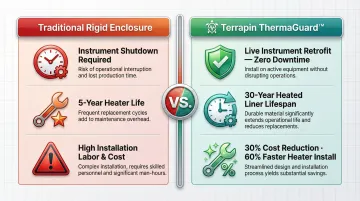
Terrapin is the only manufacturer with a patented retrofittable design that allows enclosures to be installed or replaced around live instruments without taking them offline. Key performance advantages include:
- Eliminates offsite integration delays and schedule breaks
- Reduces total installation cost by 30%
- Cuts heater installation time by 60%
- Patent-pending heated liner rated for T6 hazardous areas, with a 30-year heater cable life expectancy versus 5 years for conventional finned heaters
| Feature | Details |
|---|---|
| Protection Rating | IP 66 (Retrofittable Enclosure), IP 65 (Expandable Enclosure); heated liner rated for T6 hazardous areas |
| Key Product Types | Modular retrofittable instrument enclosures, expandable enclosures, heated liner systems with integrated bundle/power/control wire entries |
| Best Suited For | Oil and gas field installations requiring minimal downtime during enclosure replacement, cold-climate winterization, and hazardous area compliance |
Emerson / Appleton
A widely specified brand for hazardous location electrical products in North American refineries and offshore platforms, Emerson's Appleton brand manufactures explosion-proof and dust-ignition-proof enclosures including conduit bodies, junction boxes, and instrument housings rated for NEC Division 1/2 and Zone applications.
What sets Appleton apart is its extensive Division 1 explosion-proof certification depth, a catalog covering virtually every oil and gas electrical enclosure need, and deep specification history in North American refineries and LNG facilities.
| Feature | Details |
|---|---|
| Protection Rating | NEMA 4, 4X, 7, 9; UL/CSA certified for Class I, II Division 1 and 2 hazardous locations |
| Key Product Types | Explosion-proof junction boxes, conduit bodies, instrument enclosures, pushbutton stations |
| Best Suited For | North American oil refineries, chemical plants, and offshore platforms requiring Division 1 explosion-proof compliance |
Eaton (Crouse-Hinds)
Eaton's Crouse-Hinds division is one of the longest-established manufacturers of hazardous area electrical equipment, with instrument enclosures widely specified across upstream and downstream oil and gas globally. Product lines include explosion-proof, flameproof, and increased-safety enclosures for both North American and international (ATEX/IECEx) standards.
The key advantage here is dual NEC/ATEX certification capability, backed by engineering-support infrastructure for project-scale specifications and a broad material range — stainless steel, aluminum, and GRP (glass-reinforced polyester) for corrosive offshore environments.
| Feature | Details |
|---|---|
| Protection Rating | NEMA 4X, 7, 9; ATEX, IECEx; Class I/II/III Division 1 and 2 |
| Key Product Types | Flameproof and explosion-proof enclosures, GRP instrument housings, junction boxes, marshalling panels |
| Best Suited For | Large-scale oil and gas projects requiring ATEX/IECEx certification alongside North American NEC compliance |
Pepperl+Fuchs
German-headquartered manufacturer with deep expertise in explosion protection for process automation. Pepperl+Fuchs produces a broad range of field enclosures and terminal compartments designed for Zone 1/2 and Division 1/2 hazardous areas used extensively in oil and gas processing and offshore installations.
Engineers specify Pepperl+Fuchs primarily for precision instrument integration at the field-to-control-system interface, strong IECEx and ATEX certifications, and advanced purge and pressurization systems for hazardous classified areas.
| Feature | Details |
|---|---|
| Protection Rating | ATEX, IECEx, FM, CSA; Zone 1/2, Division 1/2 |
| Key Product Types | Stainless steel and GRP field enclosures, terminal compartments, purge and pressurization systems |
| Best Suited For | Process automation instrument housings in Zone 1/2 classified areas, petrochemical and offshore applications |
Rittal
A German manufacturer known for highly configurable modular enclosure systems, Rittal offers stainless steel, aluminum, and polycarbonate enclosures used in oil and gas facilities worldwide. Their modular cabinet and junction box systems adapt readily to instrument and control panel installations.
Rittal is best known for its global manufacturing scale, extensive IP66/IP67-rated product range, and engineering software (RiPanel) that allows project engineers to configure and document enclosure assemblies for large EPC projects.
| Feature | Details |
|---|---|
| Protection Rating | IP 66, IP 67, NEMA 4, 4X; optional ATEX-certified variants |
| Key Product Types | Stainless steel and polycarbonate wall-mount enclosures, junction boxes, control panels, modular cabinet systems |
| Best Suited For | EPC and large refinery/petrochemical projects requiring standardized, configurable enclosure families with global supply chain support |
nVent Hoffman
nVent Hoffman is a major North American industrial enclosure brand offering steel, stainless steel, and fiberglass enclosures across a wide range of NEMA ratings. Widely used in oil and gas process facilities for junction boxes, instrument housings, and outdoor control panels.
Hoffman's advantage is a broad portfolio of pre-engineered NEMA 4X fiberglass and stainless steel enclosures suited for corrosive petrochemical environments, backed by an established North American distribution network and customization services.
| Feature | Details |
|---|---|
| Protection Rating | NEMA 4, 4X, 12; UL Listed, cUL Listed |
| Key Product Types | Steel and stainless steel junction boxes, fiberglass NEMA 4X enclosures, instrument and control panels |
| Best Suited For | North American petrochemical and refinery facilities requiring NEMA 4X corrosion-resistant instrument enclosures with fast local sourcing |
Adalet
Cleveland, Ohio-based manufacturer specializing in explosion-proof and hazardous location enclosures since the early 20th century. Adalet products are specified in oil refineries, gas processing plants, and offshore platforms requiring NEC Class I Division 1 and 2 compliance.
Adalet stands out for its long heritage in custom-engineered hazardous area enclosures, UL/CSA certifications for Division 1 environments, and the ability to produce custom stainless steel and aluminum housings matched to specific instrument footprints common in oil and gas field installations.
| Feature | Details |
|---|---|
| Protection Rating | NEMA 4, 4X, 7, 9; UL Listed, cUL Listed; Class I Division 1/2 |
| Key Product Types | Explosion-proof junction boxes, custom instrument housings, control stations, purge and pressurization enclosures |
| Best Suited For | Custom-engineered hazardous location enclosures for oil refineries and gas processing facilities with non-standard instrument footprints |

R. Stahl
German manufacturer with over 130 years of history in explosion protection, R. Stahl produces a comprehensive range of Ex-rated enclosures for Zone 1/21 and Zone 2/22 areas used heavily in LNG, offshore, and petrochemical facilities. Their GRP and stainless steel enclosures are specified globally on major oil and gas projects.
R. Stahl is recognized for some of the most rigorous ATEX, IECEx, and global Ex certifications available, a strong offshore and LNG terminal presence, and engineering support for zone classification compliance documentation.
| Feature | Details |
|---|---|
| Protection Rating | ATEX, IECEx, Ex d, Ex e, Ex n; Zone 1/2 and Zone 21/22 |
| Key Product Types | GRP and stainless steel Ex-d (flameproof) and Ex-e (increased safety) enclosures, junction boxes, field distribution boxes |
| Best Suited For | Offshore platforms, LNG terminals, and international oil and gas projects requiring ATEX/IECEx certified Zone 1 explosion protection |
Stahlin (Allied Moulded)
Stahlin, a brand of Allied Moulded Products, manufactures fiberglass (glass-reinforced polyester) enclosures widely used in oil and gas field instrumentation due to their superior corrosion resistance, UV stability, and non-sparking properties. Popular in both onshore and offshore process environments.
The case for Stahlin is straightforward: an extensive NEMA 4X fiberglass range in a wide variety of sizes, non-conductive material suited for intrinsically safe installations, and documented resistance to hydrogen sulfide and other corrosive gases common in oil and gas processing.
| Feature | Details |
|---|---|
| Protection Rating | NEMA 4, 4X, 12; UL, cUL Listed; IP 66 |
| Key Product Types | Fiberglass GRP wall-mount enclosures, junction boxes, pull boxes, hinged-cover instrument housings |
| Best Suited For | Onshore and offshore oil and gas instrument housing in H2S-rich and highly corrosive chemical environments |
ABB
ABB is a global electrification and automation leader whose enclosure product lines span standard industrial to hazardous area certified housings for oil and gas, power generation, and petrochemical industries. ABB enclosures are often specified as part of integrated automation and control system projects.
ABB's primary advantage is seamless integration with its own instrumentation and control systems, globally certified Ex enclosures (ATEX, IECEx, NEC), and the scale to support large greenfield and brownfield projects through a single-vendor supply chain.
| Feature | Details |
|---|---|
| Protection Rating | ATEX, IECEx, NEMA 4, 4X, 7; Ex d and Ex e rated variants |
| Key Product Types | Explosion-proof junction boxes, control panels, stainless steel and GRP instrument housings, integrated automation enclosures |
| Best Suited For | Large oil and gas projects where instrument enclosures are procured as part of a broader ABB automation and control system package |
How We Chose the Best Industrial Instrument Enclosure Manufacturers for Oil and Gas
Evaluation Framework
The manufacturers on this list were assessed based on oil and gas-specific certifications (ATEX, IECEx, NEMA 4X, IP66, hazardous area classifications), demonstrated experience serving upstream/midstream/downstream and offshore applications, and range of materials suited to corrosive process environments.
Hazardous area compliance is non-negotiable. In North America, NEC Articles 500 and 505 govern Class/Division and Zone systems, while ATEX Directive 2014/34/EU and IECEx standards dominate internationally. Equipment must meet specific temperature classes, such as T6, which limits maximum surface temperature to 85°C to prevent ignition.
Common Buyer Mistakes
Over-specifying or under-specifying protection ratings represents the most frequent error. Selecting a standard NEMA 4 enclosure for a Division 1 area creates compliance violations and safety risks. Specifying explosion-proof enclosures for non-classified areas wastes budget.
Ignoring installation and maintenance complexity leads to hidden costs. Traditional rigid enclosures typically require instruments to be taken offline for enclosure replacement, costing upwards of 20 field man-hours per transmitter. For offshore operations averaging 27 days of unplanned downtime per year at costs reaching $38 million, installation efficiency becomes a direct line item in project economics.
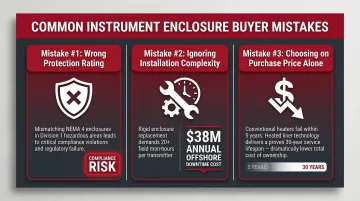
Selecting manufacturers based solely on purchase price without evaluating total lifecycle cost creates long-term problems. Conventional finned heaters fail within 5 years due to single-use thermal fuses, while advanced heated liner systems offer 30-year life expectancies — a gap that compounds across large instrument counts.
Material selection carries similar weight: 316 stainless steel and GRP provide superior corrosion resistance compared to carbon steel in offshore and H2S-rich environments.
Context-Specific Selection
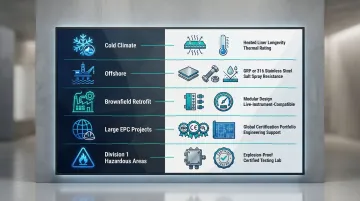
The best manufacturer for a given project depends on operational context:
- Cold-climate installations prioritize heated liner longevity and thermal performance
- Offshore applications demand corrosion-resistant GRP or 316 stainless steel construction
- Brownfield retrofits benefit from modular designs that don't interrupt live instrument operation
- Large EPC projects require global certification portfolios and engineering support infrastructure
- Division 1 hazardous areas need explosion-proof certifications from established testing laboratories
Conclusion
For oil and gas professionals, selecting the right instrument enclosure manufacturer comes down to fit: matching the site's hazardous area classification, climate conditions, maintenance philosophy, and total cost of ownership over the asset's life.
Before committing to a supplier, evaluate these operational factors — they routinely outweigh purchase price over a 20–30 year asset lifecycle:
- Heater cable life expectancy and replacement cost
- Availability of spare parts in the field
- Ease of installation on new construction vs. brownfield sites
- Whether enclosures can be replaced without taking instruments offline
For facilities dealing with schedule delays, high installation costs, or aging enclosures that need replacement without instrument shutdowns, Terrapin Industrial's patented ThermaGuard system is built around exactly that constraint — modular components that install in stages, around existing instruments, without process interruption. Contact the Terrapin team to discuss your site-specific requirements.
Frequently Asked Questions
What certifications should instrument enclosures have for oil and gas applications?
Oil and gas instrument enclosures typically require hazardous area certifications such as ATEX and IECEx for international projects or NEC Class I Division 1/2 (UL/CSA) for North American sites. Enclosures also need IP66 or NEMA 4X ratings for dust and water ingress protection in harsh environments.
What is the difference between NEMA 4X and IP66 for instrument enclosures?
NEMA 4X and IP66 are both high-level ingress protection ratings but NEMA 4X additionally addresses corrosion resistance (typically through a 200-hour salt spray test) and is the North American standard, while IP66 is the IEC international standard. The two are broadly equivalent for moisture protection but not interchangeable in regulatory submissions.
What materials are best for instrument enclosures in offshore or corrosive environments?
316 stainless steel and glass-reinforced polyester (GRP/fiberglass) are the preferred materials for offshore and corrosive environments due to their resistance to salt spray, hydrogen sulfide, and chemical exposure. Standard carbon steel enclosures are not recommended for these conditions as they lack inherent corrosion resistance and require heavy protective coatings.
How do heated instrument enclosures work in extreme cold environments?
Heated instrument enclosures use internal heating elements—heater cable, finned heaters, or heated liners—to maintain minimum operating temperatures in sub-zero environments. Modern self-regulating heated liner systems last up to 30 years and distribute heat more uniformly than traditional finned heaters, which typically fail within 5 years.
What is the advantage of a modular instrument enclosure over a traditional rigid enclosure?
Modular enclosures can be assembled in stages around existing instruments and tubing, eliminating the need to take instruments offline during installation or replacement. This reduces installation time, avoids production interruptions, and lowers total installation cost compared to rigid enclosures that require full instrument shutdown and offsite integration.
Can instrument enclosures be replaced or upgraded without shutting down the instrument?
Traditional rigid enclosures require instruments to go offline for replacement. Retrofittable modular designs—like Terrapin Industrial's patented ThermaGuard system—are engineered to be removed and replaced around live instruments without interrupting operation.