Introduction
Refineries depend on reliable instrument enclosures to protect critical measurement and control equipment from corrosive chemicals, extreme temperatures, and hazardous atmospheres. The wrong enclosure choice can trigger unplanned shutdowns costing $5 million to $10 million per hour.
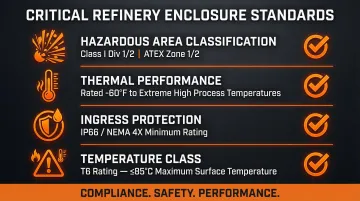
Refinery-grade instrument enclosures differ fundamentally from general electrical boxes. Standard enclosures lack the certifications, thermal management, and process-specific features refineries require. To qualify for refinery service, an enclosure must:
- Meet hazardous area classifications (Class I Div 1/2 or ATEX Zone 1/2)
- Withstand thermal cycling from -60°F to high process temperatures
- Allow safe, rapid maintenance access in live process environments
- Support straightforward field installation without taking instruments offline
Choosing the right manufacturer means knowing which of these requirements each vendor actually addresses — and where they fall short. This article evaluates the top 10 manufacturers for refinery instrument enclosure applications across hazardous area certifications, thermal management, construction approach, and installation efficiency.
Key Takeaways
- Refinery instrument enclosures require minimum IP66/NEMA 4X ratings and hazardous area certifications — Class I Div 1/2 or ATEX
- Top manufacturers differ on modular design, retrofit capability, heated liner technology, and field serviceability
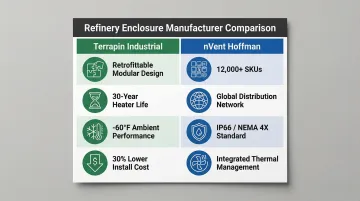
- Terrapin Industrial's retrofittable enclosures install around live instruments without taking them offline, reducing installation costs by 30%
- nVent Hoffman and Rittal offer global supply depth with 12,000+ SKUs across standard and hazardous-rated configurations
- Total lifecycle cost — including installation labor, thermal performance, and replacement frequency — typically outweighs unit price in refinery procurement decisions
What Are Industrial Instrument Enclosures and Why Do Refineries Need Them?
Industrial instrument enclosures are protective housings for field instruments—pressure transmitters, flow meters, temperature sensors, and control valves—that must survive exposure to hydrocarbon vapors, moisture, H₂S, and temperature extremes in refinery environments.
Refinery environments impose unique demands that standard electrical enclosures cannot address:
- Hazardous area classifications requiring Class I Div 1/2 (North America) or Zone 1/2 (International) compliance
- IP66 dust/water ingress ratings to withstand high-pressure washdowns and continuous moisture exposure
- Winterization requirements in sub-zero ambient conditions where inadequate heating causes impulse line freeze-ups and condensation failures
- Corrosion resistance against H₂S, salt spray, and process chemicals that attack standard painted steel
According to ISA-RP12.6 industry guidance, heated enclosures are essential in cold climates to prevent process fluid solidification and electronic component moisture damage. The T6 temperature rating (surface temp ≤ 85°C) is critical for volatile hydrocarbon environments where ignition risk is highest.
Choosing a manufacturer with refinery-specific product lines, proven hazardous area certifications, and thermal management capabilities matched to your operating conditions carries real regulatory and financial weight. The manufacturers below were selected on exactly these criteria.
Top 10 Industrial Instrument Enclosure Manufacturers for Refineries
These manufacturers were selected based on hazardous area compliance depth, IP/NEMA ratings suitable for outdoor refinery use, thermal management capability for cold environments, modular or retrofit design options, demonstrated oil & gas track record, and North American supply availability.
Terrapin Industrial
Terrapin Industrial is a Texas-based manufacturer (Richwood, TX) founded by oil and gas industry professionals who identified critical inefficiencies in traditional rigid enclosure installations. Their patented ThermaGuard modular design delivers IP66-certified retrofittable enclosures and IP65-certified expandable enclosures purpose-built for refineries, petrochemical plants, and offshore applications.
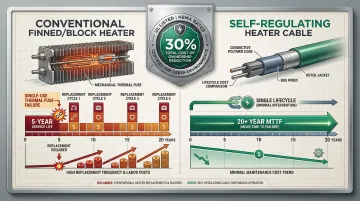
What sets Terrapin apart: the modular system allows enclosures to be installed piecemeal around live instruments without taking them offline, eliminating offsite integration and the typical 2-3 week schedule breaks. The patent-pending heated liner with heater cable supports T6 hazardous area use, maintains >75°F interior in -60°F ambient, and carries a 30-year heater life expectancy versus 5 years for conventional finned heaters. This reduces total install cost by 30% and heater installation time by 60%.
The retrofittable design enables enclosure replacement without process shutdown—a capability traditional rigid enclosures cannot offer. The quick-connect pipe stand bracket system eliminates expensive mounting bracketry, while pre-engineered holes for power wiring, control wiring, and process tubes standardize field installation across all projects.
| Attribute | Details |
|---|---|
| Key Certifications | IP66 (Retrofittable Enclosure), IP65 (Expandable Enclosure); heated liner rated for Class I Div 1 T6 hazardous areas |
| Core Product Features | Patented modular/retrofittable design; pre-engineered holes for wiring and process tubes; quick-connect pipe stand bracket; self-aligning manifold; 108–720W heater cable options |
| Best Suited For | Refineries, petrochemical plants, and process industries requiring instrument enclosure replacement or new installation in live, hazardous, or cold-climate environments without process interruption |
nVent Hoffman
nVent Hoffman is a Minnesota-based global manufacturer with over a century of history, offering a catalog exceeding 12,000 standard SKUs—including instrument enclosures, wall-mounted and free-standing housings, and thermal management systems deployed across oil and gas, energy, and process industries.
The catalog's breadth enables specification flexibility, with IP66/NEMA 4X compliance across product lines, a global distribution network for short lead times, and integrated climate control options including heaters and coolers. For large refinery projects requiring standardized, globally sourced enclosures, that supply chain depth is a practical advantage.
| Attribute | Details |
|---|---|
| Key Certifications | UL, CE, IEC, IP66, NEMA 4X |
| Core Product Features | Wall-mount, floor-standing, and junction enclosures; integrated thermal management; broad accessory ecosystem |
| Best Suited For | Large refinery projects requiring standardized, globally sourced enclosures with proven supply chain support |
Rittal
Rittal is a German-headquartered global manufacturer (est. 1961) operating across 65 subsidiaries worldwide, offering modular industrial enclosures, terminal boxes, and integrated climate control systems used in energy, automation, and process plant applications.
Modular construction enables flexible configuration with IP66 protection and UL/NEMA/IEC compliance. Built-in thermal management handles the heat and cold extremes common to refinery environments, and the VX SE system scales for facilities that need internationally standardized enclosure platforms.
| Attribute | Details |
|---|---|
| Key Certifications | UL, NEMA, IEC, IP66 |
| Core Product Features | Modular and wall-mounted enclosures in sheet steel and stainless steel; climate control units; scalable panel systems |
| Best Suited For | Refineries and process plants needing scalable, internationally standardized enclosure solutions with thermal control |
Intertec
Intertec is a Germany-based specialist in instrument and analyser enclosures for the process industry, with a catalog of approximately 2,500 products purpose-engineered for field instruments in oil & gas, petrochemical, and offshore environments.
The focus on Ex-certified (ATEX/IECEx) heated analyser shelters, corrosion-resistant GRP/fiberglass construction, and active temperature control systems makes Intertec well-suited for the harshest refinery applications—particularly where protecting analyzers in hazardous locations is the primary requirement.
| Attribute | Details |
|---|---|
| Key Certifications | ATEX, IECEx, IP66/IP67, Ex d/e rated |
| Core Product Features | GRP/fiberglass and stainless instrument enclosures; heated and air-conditioned analyser shelters; Ex-certified heaters and coolers |
| Best Suited For | Hazardous area instrument protection in upstream/downstream oil & gas and petrochemical refineries |
Pepperl+Fuchs
Pepperl+Fuchs is a global specialist in hazardous area technology headquartered in Germany (founded 1945), known for Ex-rated enclosures (GRP and stainless steel) engineered for use in Zone 1/Zone 2 and Class I Div 1/Div 2 locations common in refinery instrument installations.
Their ATEX, IECEx, and UL/cUL certifications for hazardous area enclosures, corrosion-resistant material options, and integration with their wider Ex-protection product ecosystem (barriers, isolators) make them particularly relevant for refinery instrument loops requiring comprehensive hazardous area compliance.
| Attribute | Details |
|---|---|
| Key Certifications | ATEX, IECEx, UL/cUL, IP66/IP67, Ex d/e/p rated |
| Core Product Features | GRP and stainless steel Ex enclosures; purged and pressurized enclosures; junction boxes for hazardous areas |
| Best Suited For | Refineries requiring certified Ex-rated instrument enclosures in Zone 1/2 or Class I Div 1/2 classified areas |
Hammond Manufacturing
Hammond Manufacturing is a Canadian company with over 100 years of history (founded 1917, Guelph, Ontario) manufacturing a broad range of electrical and instrument enclosures in steel, stainless steel, and aluminum, serving industries including oil and gas, power generation, and petrochemical across North America.
Their NEMA 4/4X and IP66-rated enclosure lines, broad standard product availability (approximately 4,000 SKUs), and thermal management add-ons including heaters and thermostats make them suitable for cold-climate refinery instrument protection. UL 508A and CSA listings provide North American compliance confidence.
| Attribute | Details |
|---|---|
| Key Certifications | UL, cUL, NEMA 4/4X, IP66 |
| Core Product Features | Steel, stainless steel, and aluminum enclosures; heater and thermostat accessories; standard and custom configurations |
| Best Suited For | Refineries seeking proven, readily available North American-sourced instrument enclosures across a wide size range |
Bison ProFab
Bison ProFab is a Magnolia, Texas-based manufacturer specializing in custom NEMA, UL, and ATEX-rated steel, stainless steel, and aluminum enclosures, with a strong presence in the Gulf Coast oil & gas and petrochemical market serving both OEM and end-user applications.
Their customization capabilities, short lead times, ATEX/UL ratings for hazardous areas, and Texas-based manufacturing support regional refinery procurement requirements in the U.S. Gulf Coast corridor—home to the highest concentration of refining capacity in North America.
| Attribute | Details |
|---|---|
| Key Certifications | UL, ATEX, NEMA 4/4X, IP66 |
| Core Product Features | Custom steel, stainless steel, and aluminum NEMA enclosures; hazardous area-rated options; short lead times |
| Best Suited For | Gulf Coast refineries and petrochemical plants requiring custom-built, locally sourced enclosures with quick turnaround |
Stahlin Enclosures (Hubbell)
Stahlin Enclosures (a Hubbell brand, est. 1935, Belding, MI) is a leading manufacturer of non-metallic fiberglass and reinforced polyester enclosures widely used in corrosive industrial environments, including chemical processing and oil & gas facilities where metallic enclosures are susceptible to H₂S and chemical attack.
Their corrosion-resistant GRP construction, NEMA 4X/IP66 ratings, and lightweight design reduce installation labor costs in refinery environments where corrosion from process chemicals is a primary concern. RoHS compliance adds environmental regulatory alignment.
| Attribute | Details |
|---|---|
| Key Certifications | UL, NEMA 4X, IP66, RoHS |
| Core Product Features | Fiberglass (GRP) and reinforced polyester enclosures; non-metallic construction resistant to H₂S and chemicals; multiple sizes |
| Best Suited For | Refinery areas with high corrosion exposure (sour gas, chemical splash zones) where metallic enclosures have short service life |
NEMA Enclosures
NEMA Enclosures is a Houston, Texas-based manufacturer offering standard and fully custom enclosures in carbon steel, 5052 aluminum, and 304/316L stainless steel with fast make-to-order lead times—as little as 5 business days for standard units—and compliance with NEMA 3R/4/4X and IP ratings.
Their value proposition for refineries: proximity to major Gulf Coast refinery hubs, multiple material grades including 316L stainless for corrosive environments, and the ability to quickly fabricate custom-sized enclosures to fit non-standard instrument configurations. This agility is critical during turnarounds with tight schedules.
| Attribute | Details |
|---|---|
| Key Certifications | NEMA 3R/4/4X, IP66, UL, IECEx (select models) |
| Core Product Features | Carbon steel, 5052 aluminum, 304/316L stainless enclosures; fast 5-day lead times; custom fabrication with anodizing and silk-screening |
| Best Suited For | Refineries requiring fast-turnaround, custom-sized stainless or aluminum instrument enclosures, especially in the U.S. Gulf Coast region |
Industrial Enclosure Corporation (IEC)
Industrial Enclosure Corporation is an Aurora, Illinois-based UL-listed manufacturer with nearly 50 years of experience producing custom, modified-standard, and standard electrical and industrial enclosures in stainless steel and aluminum, serving oil & gas, utilities, and process industry clients with tailored enclosure solutions.
Their expertise in custom thermal management and insulation solutions, EMI/RFI protection options, and track record delivering to oil & gas sector specifications including weatherproof and corrosion-resistant configurations makes them suitable for refineries with unique or non-standard requirements.
| Attribute | Details |
|---|---|
| Key Certifications | UL Type 3R/4X, NEMA 4/4X, IP66 |
| Core Product Features | Custom and modified-standard stainless and aluminum enclosures; thermal management and insulation; EMI/RFI shielding options |
| Best Suited For | Refineries with unique or non-standard instrument enclosure specifications requiring custom engineering support and UL certification |
How We Chose the Best Instrument Enclosure Manufacturers for Refineries
Manufacturers were assessed against five core criteria:
- Hazardous area certification depth (ATEX, IECEx, Class I Div 1/2)
- IP/NEMA protection ratings for outdoor refinery environments (minimum IP66/NEMA 4X)
- Thermal management capability for winterized instrument protection
- Material suitability for corrosive atmospheres (stainless steel, GRP)
- Demonstrated deployment in oil & gas or petrochemical facilities
A common procurement mistake is selecting general-purpose enclosures based solely on price without verifying Ex-area compliance or thermal adequacy. API RP 500 warns that non-certified equipment in classified areas can void insurance policies and trigger regulatory fines.
FM Global data suggests that UL-listed, NEMA-rated enclosures reduce total cost of ownership by 30% over 10 years compared to non-listed alternatives.
Additional factors affecting operational outcomes:
- Modular or retrofittable designs that reduce shutdown risk and cut installation labor
- Reliable lead times that align with turnaround and maintenance windows
- Local or regional supply availability to cover urgent field needs
- Total lifecycle cost, including heater longevity — self-regulating cables exceed 20 years MTTF versus 5–7 years for block heaters
These factors regularly determine whether a capital project stays on schedule — and whether the enclosure still performs reliably in year 15.
Conclusion
Selecting the right instrument enclosure manufacturer for a refinery goes beyond IP ratings. It requires aligning the enclosure's thermal performance, hazardous area certification, and installation design with the specific operational constraints of the plant—including whether instruments can afford to go offline during maintenance.
Procurement and engineering teams should evaluate enclosures on total lifecycle cost and field serviceability, not just initial unit price. Key criteria include:
- Demonstrated oil & gas or refinery-specific experience
- Verified hazardous area certifications (confirm via the UL Product iQ database)
- Thermal management systems validated for your site's climate range
- Enclosure designs that support maintenance without taking instruments offline
Terrapin Industrial's patented modular enclosures are built specifically around the criteria above—retrofittable designs that eliminate instrument downtime during replacement and reduce total installation costs by 30%. Contact their team at (281)-615-1429 or (210)-219-2821 to discuss your specific application requirements.
Frequently Asked Questions
What IP or NEMA rating should instrument enclosures have for refinery outdoor use?
Outdoor refinery instrument enclosures should meet a minimum of IP66 or NEMA 4X. IP66 protects against high-pressure water jets and dust ingress, while NEMA 4X adds critical corrosion resistance requirements. Corrosive environments (H₂S, salt spray) require NEMA 4X stainless steel or fiberglass construction, as IP66 alone does not guarantee corrosion protection.
What is the difference between an instrument enclosure and a general electrical enclosure?
Instrument enclosures are purpose-designed to house field instruments (transmitters, sensors, analyzers) in process environments. They include pre-engineered process tube entries, thermal management systems, and hazardous area ratings (Class I Div 1/2, ATEX) not typically found in standard electrical panel enclosures designed for wiring and control gear.
Do instrument enclosures for refineries need to be heated?
In cold climates, heated instrument enclosures prevent condensation, impulse line freeze-up, and instrument failure. Heater selection matters: self-regulating cable systems outlast conventional finned heaters by a wide margin. Temperature class ratings must also align with the process area's gas group — T6 is standard for most refinery applications.
What hazardous area certifications are required for refinery instrument enclosures?
In North America, Class I Division 1 or Division 2 (NEC) ratings are standard; international projects require ATEX or IECEx certification. The temperature class (T-rating) must also match the area's gas group — T6 (surface temp ≤ 85°C) is common for refineries.
Can instrument enclosures be replaced without shutting down the instrument?
Traditional rigid enclosures require the instrument to go offline for replacement, causing process interruption and schedule delays. Modular retrofittable designs — such as Terrapin Industrial's ThermaGuard system — are engineered for enclosure replacement around live instruments using quick-connect manifolds and removable outer shells, with no process shutdown required.
How long do heaters in instrument enclosures typically last?
Conventional finned or block-style heaters carry a 5-year service life and fail due to single-use thermal fuses. Self-regulating heater cable systems reach >20 years MTTF, cutting long-term maintenance costs — particularly valuable in remote or hard-to-access field locations.