Introduction
Outdoor electrical enclosures in oil and gas, petrochemical, and power generation face sustained UV exposure that degrades materials, compromises seal integrity, and ultimately risks instrument failure. For engineers and procurement teams, that translates directly to costly downtime, safety incidents, and premature equipment replacement.
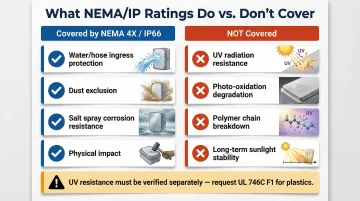
Here's the problem: NEMA and IP ratings do not inherently account for UV resistance. An enclosure can achieve NEMA 4X or IP66 certification for water and corrosion protection while remaining fully vulnerable to UV degradation. Facilities that overlook this gap in their specifications often see enclosures fail well before their rated service life.
This article covers the top materials used in UV-resistant outdoor electrical enclosures, what makes each suitable (or limited) for specific industrial applications, and what to evaluate when selecting the right one for your environment.
Key Takeaways
- UV resistance is not covered by NEMA or IP ratings—material selection must be verified separately
- Fiberglass/GRP offers the strongest native UV resistance, with a 20+ year outdoor service life in most climates
- UV-stabilized polycarbonate requires resin-stage inhibitors—not surface coatings—to perform reliably outdoors
- Stainless steel 316L is inherently UV-resistant and the premium choice for corrosive outdoor environments
- Coating-dependent UV protection degrades faster in high-UV and high-humidity industrial sites—base material matters
Why UV Resistance Is Critical for Outdoor Electrical Enclosures
UV radiation initiates photo-oxidation in polymer materials, breaking down polymer chains through chain scission while simultaneously causing crosslinking. This degradation manifests as embrittlement, color bleaching, warping, and loss of structural integrity — all of which compromise enclosure seal performance over time.
What starts as surface discoloration can progress to micro-cracking, allowing moisture ingress that leads to short circuits and complete instrument failure.
Industries where UV exposure is a primary concern include:
- Oil and gas field installations with instruments in direct sunlight for years
- Petrochemical plants with elevated ambient temperatures amplifying UV damage
- Power generation substations with minimal shade structures
- Offshore platforms facing combined UV and salt spray exposure
- Mining sites in high-altitude locations with intensified UV radiation
The critical distinction: NEMA 4X and IP66 ratings certify protection against water, dust, and corrosion but do not test for or guarantee UV stability. According to NEMA's own documentation, these standards address ingress protection and corrosion resistance through salt spray testing, but UV resistance testing is not included. Confirm UV compatibility with the manufacturer before final selection. For plastic materials, request UL 746C F1 certification, which specifically verifies outdoor UV performance.
Top Materials for UV Resistance in Outdoor Electrical Enclosures
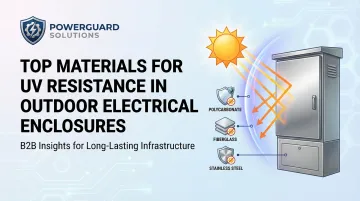
The following materials are evaluated based on UV resistance performance, structural durability under prolonged sunlight exposure, corrosion resistance, and suitability for industrial outdoor applications.
Fiberglass / Glass Reinforced Polyester (GRP)
Fiberglass/GRP is a non-metallic thermoset composite that is inherently UV-resistant, widely used in outdoor industrial enclosures across oil and gas, chemical, and marine environments. Its non-corrosive and structurally stable nature under prolonged sunlight exposure makes it a top choice for harsh environments.
Fiberglass does not suffer structural loss from UV exposure. Surface bleaching (discoloration) may occur over time, but material strength is preserved for decades—often exceeding 20 years of service life.
It resists corrosion from salt spray, chemicals, and moisture without needing metallic protection or additional coatings. This makes it particularly valuable in coastal and offshore settings where combined UV and salt exposure would rapidly degrade other materials.
One consideration: fiber blooming can occur if the external gelcoat is damaged, exposing glass fibers. Proper gelcoat maintenance extends service life significantly.
| Property | Detail |
|---|---|
| UV Resistance Level | High — inherently UV-resistant; structural integrity maintained for decades in direct sunlight |
| Best Suited For | Coastal/offshore, chemical processing, oil and gas, corrosive outdoor environments |
| Key Limitation | Surface bleaching/discoloration over time; heavier than polycarbonate; higher cost than plastic alternatives |
UV-Stabilized Polycarbonate
UV-stabilized polycarbonate is a thermoplastic enclosure material that is lightweight, impact-resistant, and widely used in outdoor electrical applications when UV inhibitors are compounded into the resin during manufacturing. Without these stabilizers, standard polycarbonate degrades rapidly under direct sunlight—often within just a few years.
UV-stabilized polycarbonate extends the usable outdoor lifespan to 10-20 years compared to untreated polycarbonate. It's the most cost-effective non-metallic option for outdoor enclosures, available with NEMA 4X and IP66/68 ratings.
It can also be machined easily on-site for conduit and cable entries—important for flexible industrial installation.
Critical specification note: Specifiers should confirm UV stabilization is a resin-stage additive that blocks 100% of UV radiation below 385nm, not just a surface coating. Resin-stage inhibitors provide uniform protection throughout the material thickness, while surface coatings wear off over time. Look for UL 746C F1 certification to verify outdoor suitability.
| Property | Detail |
|---|---|
| UV Resistance Level | Moderate to High — only with UV inhibitors in resin; uncoated polycarbonate degrades within years |
| Best Suited For | Outdoor industrial control panels, instrumentation enclosures, moderate temperature environments |
| Key Limitation | Susceptible to warping in extreme heat; UV stabilization quality varies by manufacturer; not suitable for high-impact or high-temperature environments without reinforcement |
Stainless Steel (304 / 316L)
Stainless steel is the premium metallic option for outdoor electrical enclosures, with grades 304 and 316L most commonly specified. 316L offers superior chloride resistance for marine, offshore, and coastal applications in addition to excellent UV stability.
Stainless steel is inherently UV-resistant due to its reflective metallic surface, which does not absorb UV radiation in ways that degrade the material. It dissipates heat effectively and supports wide customization for large or complex enclosures—making it the material of choice in food processing, wastewater, pharmaceutical, and marine environments where hygiene, corrosion resistance, and long service life are critical requirements.
Grade selection matters:
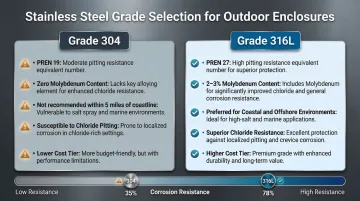
- 304 stainless: Not recommended within 5 miles of a coast due to pitting susceptibility in chloride-rich environments; PREN of 19
- 316L stainless: Contains 2-3% molybdenum, providing a PREN of 27—quantifying its superior resistance to chlorides; preferred for coastal and offshore installations
Note that stainless steel is electrically conductive and requires grounding measures.
| Property | Detail |
|---|---|
| UV Resistance Level | Excellent — reflective surface; no UV degradation; preferred for highest-criticality outdoor applications |
| Best Suited For | Marine/offshore, chemical plants, food processing, outdoor substations, high-temperature outdoor environments |
| Key Limitation | Significantly heavier and more expensive than non-metallic alternatives; installation is more labor-intensive |
Powder-Coated / Anodized Aluminum
Aluminum enclosures—die-cast and extruded variants—offer a lighter-weight metallic alternative to stainless steel. With high-quality powder coating or anodizing applied, both create a durable barrier against UV radiation and corrosion.
Aluminum offers an excellent strength-to-weight ratio, making it easier to install in elevated or hard-to-reach outdoor locations compared to stainless steel. Powder coating in UV-stable pigments—light-colored or reflective finishes—prevents UV absorption and extends the coating's life.
The critical factor: The protective finish matters more than the aluminum substrate itself. Coating quality and adhesion specification are essential for outdoor applications. AAMA 2605 represents the highest standard, requiring superior color and gloss retention for decades, while AAMA 2604 offers good durability for general industrial use but less resistance to long-term fading.
| Property | Detail |
|---|---|
| UV Resistance Level | Good — dependent on coating quality; anodized or powder-coated finishes provide reliable UV protection |
| Best Suited For | Outdoor industrial panels, telecommunications, power distribution where weight savings matter |
| Key Limitation | Coating integrity is critical—scratches or chips expose substrate to corrosion; less UV-durable than stainless steel without maintenance |
ABS Plastic with UV Inhibitors
Unlike polycarbonate or fiberglass, ABS (Acrylonitrile Butadiene Styrene) has no inherent UV resistance. It requires UV inhibitor additives or protective surface coatings to perform in direct sunlight—unprotected ABS degrades significantly faster than either alternative.
Its role: ABS offers value in lighter-duty or budget-sensitive outdoor applications where the environment is not extreme. Specifiers should always confirm UV-stabilized grades and consider the trade-off between initial cost savings and shorter replacement cycles. Even with UV stabilizers, ABS generally offers only moderate UV resistance compared to polycarbonate or GRP.
Not recommended for high-temperature, chemical-heavy, or heavy-industrial outdoor environments without additional UV protection such as painted/coated exteriors or physical shade structures.
| Property | Detail |
|---|---|
| UV Resistance Level | Low to Moderate — UV stabilizers or external coatings required; shorter outdoor lifespan than fiberglass or polycarbonate |
| Best Suited For | Light-duty outdoor applications, lower-temperature environments, general commercial installations |
| Key Limitation | Not suitable for industrial or hazardous outdoor environments without additional UV protection; susceptible to brittleness under UV and thermal cycling |
Additional UV Protection Methods for Any Enclosure Material
Regardless of material choice, UV-protective coatings, paints, and resins can be applied to enclosure exteriors to absorb or reflect UV radiation before it reaches the enclosure substrate. Opaque finishes perform best because they block UV entirely rather than scattering it. Light colors (white, light grey) reflect sunlight, reducing heat absorption and minimizing material degradation. Coating durability is verified using ASTM G154 fluorescent UV or ISO 4892 xenon arc accelerated weathering tests.
Physical shading is a practical supplemental measure for fixed outdoor installations. An opaque weatherproof sun shade or canopy mounted above the enclosure stops direct UV exposure without altering the enclosure itself—particularly useful for retrofits where the existing enclosure material is not UV-optimized.
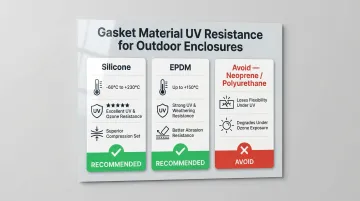
Gasket material selection matters even when the enclosure body is UV-stable. UV-degradable gaskets will harden, crack, and lose seal integrity over time — undermining an otherwise sound enclosure design. Compare the common options:
- Silicone: Excellent UV, ozone, and extreme-temperature resistance (-60°C to +230°C / -76°F to +446°F); superior long-term compression set
- EPDM: Strong weathering, ozone, and UV resistance with better abrasion resistance than silicone; lower temperature ceiling (~150°C / ~300°F)
- Avoid: Neoprene and polyurethane gaskets, which lose flexibility and degrade under prolonged UV and ozone exposure
How to Choose the Right UV-Resistant Material for Your Application
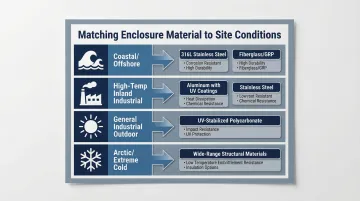
Align material selection with the specific environmental stressors of your site:
- Coastal/offshore environments: Demand 316L stainless steel or fiberglass/GRP for combined UV, salt spray, and humidity resistance
- High-temperature inland industrial sites: May favor aluminum with UV-stable coatings or stainless steel for heat dissipation
- General industrial outdoor installations: Can use UV-stabilized polycarbonate for a cost-effective solution with 10-20 year service life
- Arctic or extreme cold locations: Require materials that maintain structural integrity across wide temperature ranges
Request written confirmation from enclosure manufacturers that UV stabilization is a resin-stage or substrate-level property—not merely a surface coating applied post-manufacture. Surface-applied UV protection wears off over time and cannot match the durability of material-integrated UV resistance.
For certification benchmarks, verify UL 746C F1 for plastic enclosures and specify AAMA 2605 for powder-coated aluminum to ensure maximum durability.
For applications where those standards are non-negotiable—oil and gas, petrochemical, and process industry sites—Terrapin Industrial's IP 66-rated retrofittable instrument enclosures are engineered to meet them from the ground up. The modular design allows enclosure replacement without taking instruments offline, reducing operational risk during changeouts in active field installations.
The enclosures use ASA plastic with glass reinforcement for enhanced UV resistance and can maintain internal temperatures above 75°F in -60°F environments when equipped with heated liner systems.
Conclusion
UV resistance in outdoor electrical enclosures is a material-level property that must be actively specified — NEMA and IP ratings don't cover it. Fiberglass/GRP, UV-stabilized polycarbonate, and stainless steel 316L lead the options for demanding industrial applications, while aluminum with protective coatings offers a practical middle ground.
No single material suits every environment. Match your selection to the conditions the enclosure will actually face:
- Temperature extremes and thermal cycling
- Chemical or solvent exposure
- Coastal salt spray and humidity
- Hazardous area classification
For oil and gas, petrochemical, power generation, and marine facilities that need outdoor-rated instrument enclosures, Terrapin Industrial offers IP 66-certified modular enclosure systems with a retrofittable design that cuts total installation time and cost by 30%. Contact Terrapin Industrial to discuss which configuration fits your site conditions.
Frequently Asked Questions
What is the best material for outdoor electrical enclosures?
Fiberglass/GRP and 316L stainless steel are the top choices for harsh outdoor industrial environments due to their inherent UV and corrosion resistance, with service lives exceeding 20 years. UV-stabilized polycarbonate is a practical option for moderate environments with a 10–20 year lifespan.
Which type of outdoor enclosure will protect electrical equipment from corrosive agents?
NEMA 4X and IP66-rated enclosures made from 316L stainless steel, fiberglass/GRP, or UV-stabilized polycarbonate are the leading options for corrosive outdoor environments—including exposure to salt air, chemicals, and moisture. Material selection should match the specific corrosive agents present at your site.
What NEMA enclosure type is best suited for outdoor watertight applications?
NEMA 4X provides dust and hose-directed water protection with corrosion resistance, making it the most commonly specified rating for outdoor watertight applications. NEMA 6 and 6P add submersion protection for flood-prone or marine locations, though neither includes UV resistance testing.
Does a NEMA or IP rating guarantee UV resistance for outdoor enclosures?
No. NEMA and IP ratings do not test or certify UV resistance—these ratings address water, dust, and corrosion only. UV stability must be verified separately with the manufacturer, particularly for plastic enclosures intended for direct sunlight exposure. Request UL 746C F1 certification for plastic materials.
How long do outdoor electrical enclosures last in direct sunlight?
Lifespan varies by material:
- Fiberglass/GRP and stainless steel: 20+ years in direct sunlight with minimal degradation
- UV-stabilized polycarbonate: 10–20 years, depending on UV inhibitor quality
- Unprotected ABS or standard polycarbonate: Structural degradation possible within a few years