Introduction
In industries like oil and gas, petrochemical, and power generation, instrument enclosures represent the last line of defense between critical sensing equipment and conditions that trigger equipment failure, unplanned downtime, or safety incidents. The financial stakes are clear: Fortune Global 500 companies lose approximately $1.5 trillion annually to unplanned downtime, equivalent to 11% of their turnover. In oil and gas alone, a single hour of downtime can cost nearly $500,000.
Challenging environments span a wide range of conditions, each demanding specific enclosure specifications:
- Extreme cold — northern oil fields where ambient temperatures plunge to -60°F
- Corrosive atmospheres — offshore platforms and petrochemical plants with H2S exposure
- Airborne particulates — mining operations and cement facilities with heavy dust loading
- Hazardous area classifications — locations requiring explosion-proof or intrinsically safe construction
Under-specifying for any of these conditions isn't a minor oversight. It's a direct path to equipment failure and unplanned outages.
Given those consequences, selecting the right enclosure requires more than checking a rating number. This guide covers the environmental threats enclosures must address, how to interpret NEMA and IP protection standards, material selection for corrosive service, thermal management in sub-zero climates, and why installation method matters as much as the specification itself.
Key Takeaways
- Match enclosures to on-site threats — dust, moisture, corrosion, temperature extremes, and hazardous area classifications each require different specs
- NEMA and IP ratings aren't interchangeable: NEMA 4X covers corrosion and gasket testing that IP66 doesn't require
- Material choice (carbon steel, stainless, aluminum, fiberglass) directly impacts service life in corrosive environments
- Below -40°F, passive insulation alone won't maintain instrument operating range — active heating is required
- Modular retrofittable designs eliminate instrument shutdown during enclosure replacement, cutting installation costs by 30%
The Challenges Facing Industrial Electrical Enclosures
Industrial enclosures face far more than basic weather exposure. The hazards vary by site, but the most damaging include:
- Extreme temperature swings — sub-zero northern oil fields, thermal cycling during seasonal shutdowns
- Corrosive chemicals and salt-laden air on offshore platforms and petrochemical sites with H2S exposure
- Airborne dust and particulates in mining operations and cement manufacturing
- Flammable gas atmospheres requiring hazardous area classification compliance
The Cost of Getting It Wrong
Unplanned downtime costs U.S. manufacturers up to $207 million weekly, with 45% of facilities reporting outages lasting up to 12 hours. The consequences of mismatched enclosure specifications include:
- Premature gasket failure from UV degradation or chemical attack
- Internal corrosion when enclosure material can't withstand chloride or H2S exposure
- Instrument freeze-up when heating systems fail in sub-zero temperatures
- Condensation-induced electrical faults from inadequate sealing or thermal cycling
- Unplanned process shutdowns that halt production across plant-wide production losses
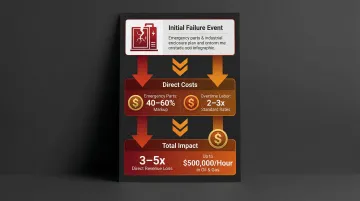
The financial damage compounds quickly. Emergency parts carry 40–60% markups, overtime labor runs 2–3x standard rates, and total impact often reaches 3–5 times the direct revenue loss.
The Protection-Practicality Tension
Higher-rated enclosures provide superior protection but create real installation challenges. They're heavier, more expensive, and difficult to install around live instrumentation. Traditional rigid enclosures require instruments to be taken offline for installation or replacement—a process that can consume 20+ field man-hours per transmitter and trigger 2-3 week schedule breaks when offsite integration is required.
That tradeoff — better protection at the cost of longer outages — is precisely the problem modular enclosure designs are built to solve.
Protection Standards: What NEMA and IP Ratings Actually Mean for Harsh Environments
NEMA Rating System: More Than Just Ingress Protection
NEMA (National Electrical Manufacturers Association) ratings cover not just dust and water ingress but also corrosion resistance, gasket durability, and construction quality. Worth noting: NEMA ratings can be self-declared by manufacturers, while UL listing (e.g., UL 508A) requires third-party testing and ongoing audits. For North American industrial installations, specifying both is standard practice.
Key NEMA ratings for challenging environments:
NEMA 4: Watertight, dust-tight, indoor/outdoor use. Must withstand hose-down test (65 gallons/minute from 1-inch nozzle at 10-15 feet for 5 minutes). Suitable for general outdoor industrial applications.
NEMA 4X: Includes all Type 4 requirements plus corrosion resistance. Requires 200-hour salt spray test (ASTM B117 equivalent) and ice formation testing. The minimum standard for outdoor industrial, offshore, or chemical environments.
NEMA 12: Industrial dust-tight for indoor manufacturing. Protects against dripping non-corrosive liquids and circulating dust (cement dust test). Not suitable for outdoor or corrosive environments.
IP Ratings: International Ingress Protection
IP (Ingress Protection) ratings use a two-digit system where the first digit rates solid ingress (0-6) and the second rates liquid ingress (0-9). Relevant thresholds for industrial enclosures:
IP65: Dust-tight (6) + water jet protected (5). Test: 6.3mm nozzle, 12.5 L/min flow, 30 kPa pressure from 3 meters for 3 minutes.
IP66: Dust-tight (6) + powerful water jet protected (6). Test: 12.5mm nozzle, 100 L/min flow, 100 kPa pressure from 3 meters for 3 minutes.
These IP thresholds look similar to NEMA 4/4X on paper—but the two systems don't map cleanly onto each other.
Critical Distinction: NEMA ≠ IP
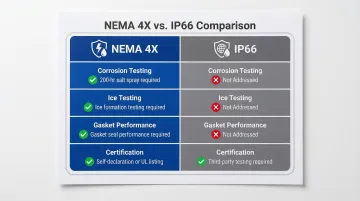
While rough correlations exist (NEMA 4X ≈ IP66), NEMA standards require additional testing for corrosion resistance and gasket performance that IP ratings do not address. An IP66 enclosure can corrode and fail in salt air because the IP standard doesn't test for corrosion. NEMA 4X also requires external mechanisms to remain operable when ice-laden—a requirement IP ratings ignore.
Key differences:
| Standard | Corrosion Testing | Ice Testing | Gasket Performance | Certification |
|---|---|---|---|---|
| NEMA 4X | Required (200-hr salt spray) | Required | Required | Self-declaration or UL listing |
| IP66 | Not addressed | Not addressed | Not addressed | Third-party testing |
When sourcing enclosures for North American installations, request the UL listing certificate directly—don't assume IP compliance translates to NEMA compliance on the data sheet.
Hazardous Area Classifications
In locations with flammable gas or dust, ingress protection alone isn't enough—enclosures require hazardous area certification. Two classification systems govern this:
Class/Division (NEC Article 500): Used in North America
- Class I: Flammable gases/vapors
- Division 1: Hazard present under normal operation
- Division 2: Hazard present only under abnormal conditions
Zone System (IEC): Used internationally
- Zone 0/1/2 for gases
- Zone 20/21/22 for dusts
Enclosures in these areas require special construction that goes well beyond a sealed housing:
Explosion-proof: Designed to contain an internal explosion without igniting the surrounding atmosphere. NEC-rated enclosures are tested to 4x the maximum internal explosion pressure; IEC flameproof (Ex d) enclosures are tested to 1.5x—a meaningful difference for high-risk sites.
Purged/Pressurized (Type X/Y/Z or Ex p): Maintains positive pressure of a protective gas inside the enclosure, displacing flammable vapors. Requires safety interlocks to shut down equipment if pressure drops.
Temperature Class (T-Code): Every certified enclosure carries a T-code (T1–T6) marking its maximum surface temperature. T6 (85°C/185°F) is the most restrictive and applies where gases with low auto-ignition temperatures are present.
Choosing the Right Enclosure Material for Harsh and Corrosive Environments
Material selection directly determines enclosure service life in corrosive environments. Every material has compatibility limitations with specific chemicals and atmospheres — there is no single universal solution.
Core Material Options
Carbon Steel with Powder Coating
- Cost-effective for protected indoor use
- Not suitable for corrosive outdoor environments without additional treatment
- Vulnerable to coating damage and subsequent rust
304 Stainless Steel
- Good general corrosion resistance for most outdoor and chemical environments
- Not recommended within 5 miles of a coast or in areas using de-icing salts
- Vulnerable to pitting in chloride environments (>100 ppm chloride)
316 Stainless Steel
- Contains 2-3% molybdenum for superior pitting and crevice corrosion resistance
- Standard for marine and offshore environments, resisting up to 1000 ppm chloride
- Required for pharmaceutical and high-chloride chemical environments
Aluminum
- Lightweight and corrosion-resistant for moderate outdoor applications
- Suitable for solar, telecom, and general industrial use
- Susceptible to galvanic corrosion if coupled with dissimilar metals in saline environments
- Requires anodizing or powder coating for marine service
Fiberglass Reinforced Polymer (FRP)
- Non-metallic with immunity to galvanic corrosion
- Strong chemical resistance across broad range of acids and bases
- Lighter than steel, easier to modify in the field
- Excellent for coastal and chemical processing applications
- High-quality FRP with UV inhibitors prevents embrittlement
Hydrogen Sulfide (H2S) Considerations
In "sour" oil and gas environments, H2S creates risk of Sulfide Stress Cracking (SSC). NACE MR0175/ISO 15156 sets strict hardness limits — typically below 22 HRC — to prevent steel embrittlement. 316L is preferred over 304L in sour service due to better resistance to H2S-induced pitting and cracking.
The Gasket Material Equation
Once your enclosure body material is set, the gasket is the next variable to nail down. Gasket selection matters as much as the enclosure body itself — gaskets degrade from UV exposure, temperature cycling, and chemical contact, and replacing one with non-OEM material can void the enclosure's UL listing.
Gasket Material Selection:
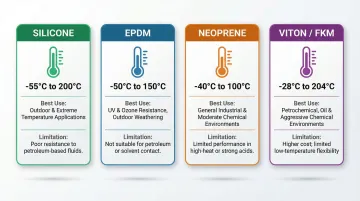
| Material | Temp Range | Best For | Limitations |
|---|---|---|---|
| Silicone | -55°C to 200°C | Outdoor, extreme temp, UV exposure | Poor abrasion resistance, high cost |
| EPDM | -50°C to 150°C | Outdoor weathering, UV/ozone resistance | Poor oil/petroleum resistance |
| Neoprene | -40°C to 100°C | General industrial, acid/base resistance | Poor UV/ozone resistance unless compounded |
| Viton (FKM) | -28°C to 204°C | Chemical/petrochemical, oil resistance | High cost, poor low-temp flexibility |
Establish inspection and replacement intervals at commissioning. Gasket accessibility should be a specification criterion for critical or remote installations.
Thermal Management and Winterization: Keeping Instruments Running in Extreme Cold
In northern North America, ambient temperatures routinely exceed the lower operating limits of standard instrumentation, so active heating is mandatory — not optional.
Instrument Operating Temperature Limits
Standard process instruments have low-temperature limits easily exceeded in arctic climates:
- Emerson Micro Motion ELITE Coriolis meters: -50°C (-58°F) minimum
- Rosemount 3417 Ultrasonic Flow Meter: -50°C (-58°F) transducers, -40°C (-40°F) electronics
- Honeywell VersaFlow Coriolis: -40°C (-40°F) standard ambient limit
When ambient temperatures drop below these thresholds, instruments freeze, fail, or read inaccurately. The goal isn't just preventing physical damage—it's maintaining instruments within their specified operating temperature range year-round.
Active Heating vs. Passive Insulation
API RP 550 guidelines mandate active heating for instruments on water, steam, or hydrocarbon service subject to freezing. It's also required for gas services where condensate could form and freeze. Passive insulation delays freezing but cannot prevent it during prolonged exposure to extreme cold.
Design winterization systems for the minimum temperature prevailing after excluding the lowest 1% of hourly readings — the 99% design condition. When the gap between ambient and required internal temperature exceeds what insulation alone can bridge, active heating is mandatory.
Traditional Heating System Limitations
Finned and block-style heaters suffer from:
- Fail within 5 years due to single-use thermal fuses that cannot be reset
- Require dismantling the enclosure and taking instruments offline to replace
- Create production risk and crew mobilization costs every maintenance cycle
Advanced Heating Solutions
Terrapin Industrial's patent-pending heated enclosure liner addresses these limitations with a ThermaGuard-integrated heater cable system featuring:
- Rated for 30-year service life versus 5 years for traditional heaters
- Delivers 108 to 720 watts output depending on cable selection (3-20 watts per foot)
- Maintains >75°F internal temperature even in -60°F ambient conditions
- Carries T6 hazardous area rating for classified oil and gas locations
- Installs in under 2 minutes — 60% faster than traditional heater replacement
The system eliminates finned heaters, rigid conduit, and GUATs, creating more spacious enclosure interiors with greater access to instrumentation.
The opposite challenge applies in warm climates. Sealed enclosures trap heat from internal components, and high-ambient or high-heat-load applications may require heat exchangers, air conditioners, or breathable IP-rated vents — provided any ventilation method preserves the enclosure's NEMA/IP rating and hazardous area classification.
Installation Challenges and the Case for Modular Enclosure Design
The Traditional Installation Problem
Conventional rigid enclosures require instruments and tubing bundles to be installed inside the enclosure before field mounting—or they require the instrument to be taken offline when the enclosure needs replacement, modification, or upgrade. This creates:
- Schedule breaks: Offsite integration historically creates 2-3 week construction delays
- High labor costs: Traditional installation can require 20+ field man-hours per transmitter
- Production risk: Any mid-life enclosure replacement requiring instrument shutdown triggers permit requirements and crew mobilization costs
Offsite integration (pre-wiring and pre-piping enclosures in a shop before field installation) adds lead time, logistics cost, and integration service fees (approximately $600 per unit). In oil and gas facilities where downtime costs $500,000 per hour, any field work requiring loop shutdown becomes prohibitively expensive.
The Modular Enclosure Concept
Modular enclosures are engineered to be assembled around existing instruments and tubing in the field without taking them offline. Three design features make this possible:
- Pre-engineered entry holes for power, control wiring, and process tubes eliminate field modifications and standardize installation across projects
- Quick-connect systems with integrated pipe stand brackets let crews mount or remove enclosures without disrupting instrument operation
- Self-aligning manifold designs allow the enclosure body to be installed before or after the instrument bundle, in any sequence the schedule demands
Real-World Implementation: Terrapin Industrial's ThermaGuard System
Those features aren't theoretical. Terrapin Industrial's patented ThermaGuard system puts them into practice:
- Piecemeal installation: Assemble around live instruments to replace aging enclosures without process shutdown
- Individual component replacement: Parts can be replaced independently rather than replacing entire assembly
- Standardized mounting: Eliminates extensive and expensive mounting bracketry
- 60% faster heater installation: Under 2 minutes versus traditional methods
- 30% reduction in total installation cost: Compounds quickly across facilities with hundreds of instrument enclosures
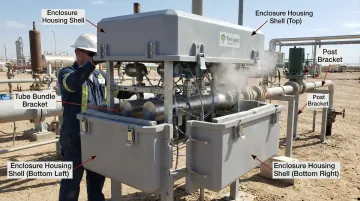
The system's IP66 (Retrofittable) and IP65 (Expandable) certifications ensure environmental protection while maintaining installation flexibility. All enclosures feature stainless steel hardware (hinges, latches, lid supports) and EPDM or Neoprene gaskets for long-term durability.
Long-Term Maintenance Efficiency
In remote or offshore locations, mobilizing a maintenance crew is expensive. Modular design reduces how often that's necessary. Key lifecycle advantages:
- Removable components allow targeted part replacement without full assembly teardown
- Standardized entry points cut troubleshooting and re-installation time on repeat visits
- Heating systems rated for 30-year service life versus 5 years for conventional finned heaters
Frequently Asked Questions
What is the difference between NEMA 4X and IP66 for industrial enclosures?
While both ratings address dust-tight and water-jet protection, NEMA 4X also requires 200-hour salt spray corrosion resistance testing and covers gasket performance and construction durability—factors that IP66 does not address. For North American industrial installations, NEMA 4X remains the stronger specification because it ensures long-term durability in corrosive environments.
Can an instrument enclosure be replaced without taking the instrument offline?
Traditional rigid enclosures typically require instruments to be decommissioned for enclosure replacement. However, modular retrofittable designs (such as Terrapin Industrial's ThermaGuard system) are engineered to be assembled around live instruments in the field, eliminating shutdown requirements entirely.
How do instrument enclosures maintain safe operating temperatures in sub-zero environments?
In extreme cold, heater cables or heating elements inside the enclosure maintain internal temperatures within the instrument's operating range. Key selection criteria include heater cable life expectancy (30 years for advanced systems versus 5 years for traditional heaters) and T-class rating, where T6 certification allows use in the most restrictive classified locations.
What makes an enclosure suitable for use in a hazardous (classified) area?
In Class I or Zone hazardous areas, enclosures and heating elements must carry temperature class (T-class) certification limiting surface temperatures below the ignition point of flammable atmospheres. T6 (85°C/185°F maximum) is the most restrictive class. Standard NEMA ratings alone do not qualify an enclosure for hazardous locations—explosion-proof or T-class certifications are also required.
How often should gaskets on industrial enclosures be inspected or replaced?
Gaskets typically last 3–7 years, depending on material, operating conditions, and temperature cycling—silicone and EPDM outperform Neoprene in UV and high-temperature service. Inspect gaskets at scheduled maintenance intervals, and treat gasket accessibility as a selection criterion for enclosures in remote or critical locations.
What are the main advantages of modular instrument enclosures over traditional rigid designs?
Modular enclosures offer several practical advantages over traditional rigid designs:
- Eliminate offsite integration and supply chain delays
- Install in stages or around live instruments without shutdown
- Allow individually replaceable components for easier maintenance
- Reduce total installation time and cost by up to 30%
In continuous process industries where downtime can exceed $500,000 per hour, the ability to replace an enclosure around a live instrument is a significant operational advantage.