Introduction
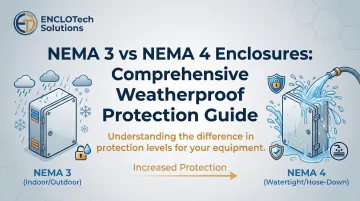
In industrial and outdoor electrical installations, selecting the wrong enclosure rating can trigger equipment failure, unplanned downtime, or failed compliance inspections. Yet NEMA 3 and NEMA 4 ratings are frequently confused or treated as interchangeable—a mistake that carries real operational consequences.
The National Electrical Manufacturers Association publishes NEMA ratings to define how well an enclosure withstands specific environmental conditions. In demanding industries like oil and gas, food processing, and marine environments, the gap between NEMA 3 and NEMA 4 is not minor — exposure to water, dust, and corrosive agents can destroy unprotected equipment fast.
This guide covers what you need to make the right call:
- What each rating actually protects against (and where it falls short)
- How NEMA 3 and NEMA 4 map to IEC/IP equivalents
- Which rating fits your application, environment, and compliance requirements
Key Takeaways
- NEMA 3 protects against rain, sleet, snow, windblown dust, and ice formation—standard for moderate outdoor use
- NEMA 4 adds resistance to hose-directed water and washdown conditions
- NEMA 3 ≈ IP55; NEMA 4 ≈ IP66 for international equipment specifications
- Both have corrosion-resistant "X" variants (NEMA 3X, NEMA 4X) for chemical exposure or salt air
- Neither is inherently explosion-proof; hazardous area classification requires separate certifications
NEMA 3 vs NEMA 4: Quick Comparison
The table below outlines the key protection differences between NEMA 3 and NEMA 4. Use it as a starting point — then check the subgroup notes below to confirm the right variant for your application.
| Feature | NEMA 3 | NEMA 4 |
|---|---|---|
| Weather Protection | Rain, sleet, snow, ice formation | All NEMA 3 protections plus hose-directed water |
| Dust Resistance | Windblown dust | Complete dust-tight seal |
| Water Resistance | Wind-driven rain (~45 GPM spray) | Hose-directed water (65 GPM at 31 kPa) |
| Ice Formation | External ice protected | External ice protected |
| Corrosion Resistance | Carbon steel (3X adds stainless/non-metallic) | Carbon steel (4X adds stainless/non-metallic) |
| Approximate IP Equivalent | IP55 | IP66 |
| Washdown Suitability | Not suitable | Fully suitable |
| Typical Industries | Utilities, traffic control, construction, telecom | Food/beverage processing, marine/offshore, petrochemical, power generation |
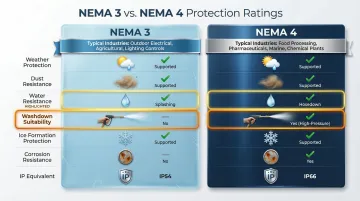
Subgroup note: NEMA 3R removes the requirement for external icing protection; 3S adds operable external mechanisms under iced conditions; 3X and 4X both add corrosion resistance through stainless steel or non-metallic construction. If your site involves washdowns or salt spray, the X variants are worth the additional cost.
What is a NEMA 3 Enclosure?
NEMA 3 enclosures provide outdoor-rated protection against falling dirt, windblown dust, rain, sleet, snow, and external ice formation. That makes them well-suited for general outdoor installations where weather resistance matters but industrial washdown or high-pressure spray is not a factor.
NEMA 3 Testing Methodology
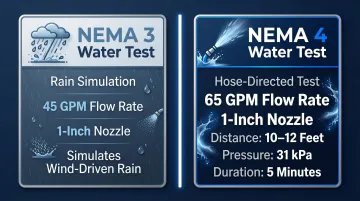
The NEMA 3 water spray test simulates wind-driven rain using approximately 45 gallons per minute (GPM) from a 1-inch nozzle. The test verifies that water does not enter the enclosure under conditions mimicking heavy weather. The dust ingress test ensures windblown particles cannot penetrate seals, while the ice formation test confirms the enclosure remains undamaged when covered in ice.
Passing these tests means the enclosure can withstand typical outdoor weather but not concentrated water streams or industrial cleaning operations.
NEMA 3 Subgroups and Their Practical Significance
NEMA 3R omits the dust test and uses overlapping metal construction (drip shields) rather than tight gasketing. It's the standard choice for outdoor utility and traffic-control boxes where rain resistance is required but dust ingress is not a concern.
NEMA 3S requires full operational functionality even when the enclosure is laden with ice. External mechanisms — handles, levers, latches — must remain operable under ice load, making this variant critical for extreme cold-climate installations.
NEMA 3X / 3RX / 3SX add corrosion resistance to the base 3, 3R, or 3S ratings:
- Must pass 600-hour salt spray testing
- Appropriate for coastal, offshore, or chemically exposed environments
- Available across all three base subgroups depending on dust and ice requirements
Use Cases of NEMA 3 Enclosures
NEMA 3 is the right fit for:
- Outdoor junction boxes and utility distribution equipment
- Traffic control systems and signal cabinets (typically 3R)
- Construction site electrical panels
- Transportation infrastructure installations
- Telecommunications equipment in sheltered-but-exposed locations
For projects that cross international specifications, NEMA 3 carries an approximate IP55 equivalency — a useful reference point when aligning with IEC-based documentation. Note that IP55 does not account for ice formation, so the equivalency is directional rather than exact.
What is a NEMA 4 Enclosure?
NEMA 4 builds on all NEMA 3 protections but adds resistance to hose-directed water and splashing water. The enclosure must remain watertight under direct water spray, making it suitable for active washdown and heavy-rain environments where NEMA 3 would fail.
NEMA 4 Testing Methodology
The NEMA 4 hose-directed water test is far more rigorous than NEMA 3. It requires water delivered at 65 GPM from a 1-inch nozzle at a distance of 10-12 feet (approximately 3 meters) for 5 minutes. Water pressure is specified at 31 kPa (approximately 4.5 psi) at the nozzle.
This concentrated stream simulates industrial washdown conditions and heavy splash exposure. No water is permitted to enter the enclosure during testing—a far more demanding standard than the 45 GPM rain simulation used for NEMA 3.
NEMA 4X: Corrosion Resistance
NEMA 4X maintains the same waterproof standard with added corrosion resistance. Common materials include:
- Type 304 or 316 stainless steel
- Fiberglass-reinforced polyester
- Polycarbonate
- Aluminum with protective coatings
One important point: NEMA 4X is not explosion-proof. Explosion-proof protection requires separate certifications — Class I Division 1/2 (NEMA Type 7/9) or ATEX classifications. The "X" suffix indicates corrosion resistance only.
NEMA 4 approximates IP66 in international standards. Terrapin Industrial's Retrofittable Enclosure carries IP66 certification, meeting NEMA 4-equivalent protection requirements for instrument enclosure applications across oil and gas, petrochemical, and power generation facilities.
Use Cases of NEMA 4 Enclosures
NEMA 4 is required for:
- Food and beverage processing washdown areas
- Marine and offshore equipment installations
- Industrial control panels exposed to direct hose spray
- Outdoor electrical panels in high-rainfall regions
- Petrochemical or power generation instrument enclosures
For industrial instrument applications in process industries—where enclosures face both weather exposure and incidental spray—NEMA 4 or its IP66 equivalent is the minimum recommended standard.
NEMA 3 vs NEMA 4: Which Should You Choose?
Key Decision Factors
Evaluate these six factors when selecting between NEMA 3 and NEMA 4:
- Exposure to direct hose spray or washdown - Will the enclosure face high-pressure cleaning or concentrated water streams?
- Proximity to high-moisture processes - Is the installation near splash zones, spray operations, or heavy marine exposure?
- Required IP equivalent for international specs - Does your project require IP66 compliance?
- Corrosion environment - Are salt air, chemicals, or corrosive agents present?
- Hazardous area classification needs - Do you need Class I Division 1/2 or ATEX certification beyond environmental protection?
- Total cost of ownership - What are the lifecycle costs including maintenance and replacement frequency?
Situational Recommendations
Choose NEMA 3 (or 3R/3S) when:
- General outdoor installations without washdown risk
- Moderate weather exposure is the primary concern
- Budget constraints favor lower upfront cost
- Dust protection is not critical (3R variant)
Choose NEMA 4 when:
- Direct water spray, industrial cleaning, or marine splash exposure is possible
- Equipment reliability in wet conditions is critical
- IP66 equivalency is required for international specifications
- The application involves food processing or pharmaceutical manufacturing
Choose NEMA 4X when:
- Corrosion from chemicals, salt water, or high humidity is an additional factor
- Coastal or offshore installations demand corrosion resistance
- Sanitary washdown with caustic agents occurs regularly
Cost vs. Protection Tradeoff
A steel NEMA 3R enclosure (approximately 29" x 24" x 12") lists for around $1,548, while comparable NEMA 4 models typically command a 30% price premium due to thicker gaskets, higher-grade sealants, and required corrosion-resistant finishes. This brings NEMA 4 enclosures to approximately $2,000+ for similar dimensions.
That 30% premium looks very different when weighed against downtime costs. Unplanned outages in process industries average $260,000 per hour — and reach $1 million per hour in oil and gas. A single water-ingress failure from an under-rated NEMA 3 enclosure in a washdown zone can trigger exactly that scale of loss.
Real-World Scenario: Offshore Platform Enclosure Upgrade
Consider an instrument enclosure on an offshore platform or petrochemical processing unit initially specified as NEMA 3. After installation, the facility introduces routine washdown procedures to maintain cleanliness and prevent contamination. The NEMA 3 enclosure begins showing moisture intrusion, requiring an upgrade to NEMA 4 (IP66) protection.
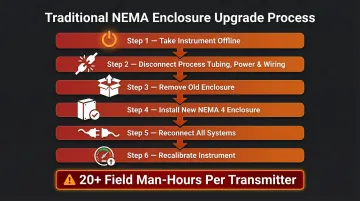
With traditional rigid enclosures, this upgrade requires:
- Taking the instrument offline
- Disconnecting process tubing, power, and control wiring
- Removing the old enclosure completely
- Installing the new NEMA 4 enclosure
- Reconnecting all systems
- Recalibrating the instrument
- Total time: upwards of 20 field man-hours per transmitter
With third-party integration, this process creates 2-3 week schedule breaks and can cost approximately $600 per unit in integration fees — before accounting for lost production time.
Terrapin's patented modular retrofittable enclosure design eliminates this problem. The system allows enclosure upgrade or replacement without instrument downtime through its quick-connect system and modular installation process. Components can be installed piecemeal around existing operational instruments, eliminating the traditional requirement for instrument shutdown. This approach reduces total installed cost by an estimated 30% below current market offerings while eliminating schedule risk.
Consequence Map: Wrong Choice Outcomes
Over-specification (choosing NEMA 4 when NEMA 3 suffices):
- Unnecessary upfront cost premium (~30%)
- Additional weight and complexity
- Wasted budget that could fund other improvements
Under-specification (choosing NEMA 3 when NEMA 4 is needed):
- Moisture intrusion and short circuits
- Premature equipment failure
- Compliance violations and failed inspections
- Unplanned downtime costing $260,000+ per hour
- Safety incidents from electrical failures
- Forced emergency replacements at premium cost
When the cost of a single downtime incident dwarfs the price difference between ratings, the right enclosure spec is rarely the place to cut costs.
Conclusion
NEMA 3 and NEMA 4 are not interchangeable. The right choice depends on specific water exposure risk, environmental conditions, and operational demands. Neither is universally "better," but under-specification carries real operational and safety consequences.
For facilities managers and engineers in oil and gas, petrochemical, and marine sectors, enclosure rating directly affects uptime, safety compliance, and total lifecycle cost. NEMA 4 provides meaningfully higher protection than NEMA 3 through its resistance to hose-directed water, making it essential for washdown environments and high-moisture applications.
When corrosion is also a factor, NEMA 4X becomes the minimum acceptable standard.
Use these four criteria to finalize your selection:
- Assess your water threat level (incidental splash vs. hose-directed)
- Evaluate corrosion risk from chemicals, saltwater, or cleaning agents
- Verify hazardous location requirements and applicable certifications
- Confirm the enclosure rating matches your actual installation environment
Specifying down to save cost is the most common mistake in enclosure selection. Match the rating to the environment — not the budget.
Frequently Asked Questions
Frequently Asked Questions
Is NEMA 4 better than NEMA 3?
NEMA 4 offers higher protection by adding resistance to hose-directed water and washdown conditions beyond NEMA 3's rain and snow protection. However, "better" depends on the application—NEMA 3 may be entirely sufficient for general outdoor use without washdown risk, making NEMA 4's premium unnecessary.
Are NEMA 4 enclosures suitable for outdoor use?
Yes, NEMA 4 enclosures are fully rated for outdoor use and exceed NEMA 3's outdoor weather requirements. They handle both standard outdoor exposure and environments with direct water spray or industrial washdown.
Are NEMA 4X enclosures explosion-proof?
No, NEMA 4X enclosures are NOT explosion-proof. The "X" suffix indicates corrosion resistance only. Explosion-proof or hazardous location ratings require separate certifications such as Class I Division 1/2 (NEMA Type 7/9) or ATEX classifications per NEC Article 500.
Do NEMA 4X enclosures have to be stainless steel?
No, stainless steel is one option for NEMA 4X, but polycarbonate and fiberglass also meet the standard. Material choice depends on the corrosive agents and conditions in your specific environment.
What is the IP rating equivalent of NEMA 3 and NEMA 4?
NEMA 3 is approximately equivalent to IP55, while NEMA 4 is approximately equivalent to IP66. Note that NEMA ratings cover factors like ice formation not addressed by IP ratings, so treat these equivalencies as approximations.
Can a NEMA 3 enclosure be used in a food processing facility?
NEMA 3 is generally not sufficient for food processing washdown areas where hose-directed spray is routine. NEMA 4 or NEMA 4X (for corrosion resistance from cleaning chemicals) is the standard minimum for washdown-intensive food and beverage environments per 3-A Sanitary Standards.