Introduction
Instrument failure in a gas turbine hall or nuclear facility doesn't just mean a bad reading — it means unplanned downtime, compliance violations, and potential safety incidents. Industrial instrument enclosures prevent that cascade, protecting pressure transmitters, flow meters, analyzers, and RTDs from extreme heat, sub-zero cold, corrosive gases, and moisture intrusion across the harshest power generation environments.
Choosing an enclosure based solely on price or availability — without validating IP/NEMA ratings, hazardous area certifications, or thermal management capability — exposes facilities to freeze-up, corrosion-induced failure, and regulatory non-compliance.
The manufacturer matters as much as the specification. A supplier's track record in power generation, depth of certifications, and ability to support field maintenance directly determine long-term reliability.
The global electrical and industrial enclosure market reflects this demand — valued at $7.83 billion in 2025 and projected to reach $15.16 billion by 2034, with the energy and power sector driving approximately 30% of total demand Fortune Business Insights, 2025.
Renewable energy build-out and grid modernization are accelerating that growth, creating sustained demand for outdoor instrumentation protection capable of surviving decades of UV exposure, salt spray, and temperature extremes.
Key Takeaways
- Power generation enclosures must meet IP/NEMA ratings, hazardous area classifications (Zone 1/2, Division 1/2), and extreme temperature thresholds
- This list covers both global enclosure leaders and hazardous-area specialists with proven power generation deployments
- Terrapin Industrial's patented retrofittable design allows enclosure replacement without instrument downtime, cutting installation costs by 30%
- Key selection factors: certifications, thermal management, material durability, and field maintenance access
- This list prioritizes proven power generation deployments, not general industrial suppliers
Overview of Instrument Enclosures in the Power Generation Industry
An industrial instrument enclosure is a protective housing engineered to shield field instruments—pressure transmitters, flow meters, analyzers, RTDs—from environmental stressors that would otherwise degrade accuracy or cause outright failure.
In power generation, those stressors are uniquely demanding:
- High-voltage proximity in substations
- Ambient temperatures swinging from arctic cold to turbine exhaust heat
- Vibration from rotating machinery
- Hazardous classified zones where explosive gas or dust atmospheres may exist
The power generation sector commands a substantial share of enclosure demand. Industry data shows that energy and power applications represent 29.73% of global enclosure demand in 2025, translating to roughly 11.8 million units annually worldwide Mordor Intelligence, 2026. In the United States alone, the energy sector accounts for 27.94% to 30% of the market Industry Research, 2025.
Two forces are driving that demand higher. Utility-scale solar and offshore wind projects now specify IP65+ enclosures rated for 25-year service lives in corrosive environments. At the same time, grid modernization is accelerating spending: the U.S. Department of Energy disbursed $3.5 billion in 2024 for grid resilience projects, much of it funding NEMA 3R outdoor cabinets with thermal management systems to protect substations from heatwaves and wildfires Mordor Intelligence, 2026.
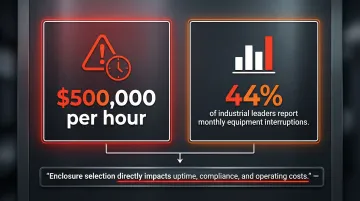
The cost of getting this wrong adds up fast. Unplanned industrial downtime can reach $500,000 per hour, and 44% of industrial leaders report equipment-related interruptions at least monthly EPRI, 2025. That's why enclosure selection in power generation isn't just a procurement checkbox — it directly affects uptime, compliance, and operating costs.
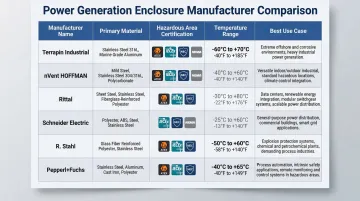
Top 10 Industrial Instrument Enclosure Manufacturers for Power Generation
Manufacturers were evaluated against five criteria, with the list prioritizing suppliers with proven field performance — not just catalog breadth:
- IP/NEMA/ATEX certification coverage
- Suitability for hazardous area classifications (Zone 1/2, Division 1/2)
- Thermal management capability (heated/insulated options for winterization)
- Installation flexibility
- Documented track record in power generation or adjacent heavy industries
Terrapin Industrial
Texas-based Terrapin Industrial was founded by power and process industry veterans who identified a persistent inefficiency in traditional enclosure installations: the requirement to take instruments offline for replacement, compounded by costly offsite integration delays.
The company's patented ThermaGuard modular instrument enclosures serve power generation, oil & gas, and petrochemical industries with IP 66 (retrofittable) and IP 65 (expandable) rated solutions.
What sets Terrapin apart: The patented quick-connect modular design allows enclosures to be installed piecemeal around live instruments without taking them offline—eliminating offsite integration, reducing total installation cost by 30%, and cutting heater installation time by 60%. The patent-pending heated liner uses heater cable with a 30-year life expectancy (versus 5 years for traditional finned/block heaters) and is rated for T6 hazardous areas, offering superior safety compared to conventional heating limited to T3 (392°F) classifications.
| Key Features | Patented retrofittable modular design; pre-engineered wire/tube entries; self-aligning manifold; quick-connect pipe stand bracket; heated liner rated for T6 hazardous areas; 108–720W heat output range |
| Certifications / Standards | IP 66 (Retrofittable Enclosure), IP 65 (Expandable Enclosure); suitable for NEC T6 classified hazardous areas |
| Best Suited For | Power generation, oil & gas, and petrochemical facilities requiring winterization or in-service enclosure replacement without instrument downtime |
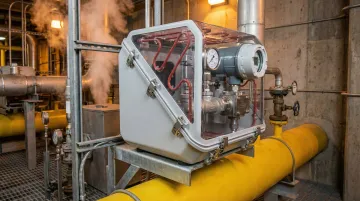
nVent HOFFMAN
nVent HOFFMAN is a leading global manufacturer of industrial enclosures and thermal management solutions, offering a comprehensive portfolio of insulated and heated instrument enclosures widely deployed across North American and international power generation, pipeline, and process plant applications.
Key differentiator: Purpose-built instrument enclosure lines with integrated electric heat tracing, broad NEMA rating coverage (Types 3R through 4X), and deep expertise in cold-climate winterization.
The ZonEx Series delivers ATEX and IECEx-certified enclosures for Zone 1 and Zone 2 hazardous applications in stainless steel and GRP configurations, with proven deployments in utility-grade solar farms requiring extreme UV and moisture resistance nVent HOFFMAN, 2024.
| Key Features | Insulated instrument enclosures with integrated heat; modular panel systems; stainless steel and fiberglass options; ZonEx Series for hazardous areas |
| Certifications / Standards | NEMA Type 4, 4X, 12; cUL Listed (File No. E61997); ATEX Directive 2014/35/EU; IECEx; IP66 |
| Best Suited For | Cold-climate power stations, pipeline monitoring, and process facilities requiring thermal management and hazardous area compliance |
Rittal
Germany-headquartered Rittal operates production facilities across 11 countries, serving IT, manufacturing, power and energy, and process industries with one of the broadest enclosure portfolios globally. The company is part of the Friedhelm Loh Group, which posted revenues of €3.1 billion in 2024 Rittal, 2024.
Why it's on this list: Rittal's integrated climate control technology — spanning air conditioning, heat exchangers, and water cooling — sets it apart from enclosure-only suppliers. The AX Plastic Ex Enclosures are certified for Zone 1, 2, 21, and 22 environments with IECEx, ATEX, and UL HazLoc approvals, purpose-built for explosion hazard areas in the energy sector Rittal, 2024. A global supply chain also means shorter lead times for large-scale deployments.
| Key Features | Modular enclosure systems; integrated climate control; stainless steel and fiberglass variants; AX Plastic Ex line for hazardous areas |
| Certifications / Standards | IECEx, ATEX, UL HazLoc (Class I, Zone 1/2); IP66, NEMA 4X; UL 508A, UL 746 |
| Best Suited For | Large-scale power generation and energy distribution facilities requiring standardized, globally-sourced enclosures with advanced thermal management |
Schneider Electric
French multinational Schneider Electric offers its Universal Enclosures range (formerly Spacial/Thalassa) covering steel wall-mounted, floor-standing, stainless steel, and insulating enclosures, backed by extensive presence in the global power and energy sector.
What sets Schneider apart: Deep integration with broader power management ecosystems, comprehensive thermal management accessories through the ClimaSys line, and strong compliance credentials across IEC, NEMA, and IP standards. The PanelSeT Series includes steel, stainless steel, and insulated polyester enclosures for harsh outdoor and electrical environments, compliant with IEC 62208 for empty enclosures Schneider Electric, 2025.
| Key Features | Universal Enclosures range (PanelSeT Series); steel and stainless steel options; ClimaSys thermal management accessories; floor-standing and wall-mount configurations |
| Certifications / Standards | IEC 62208 compliance; IP ratings for ingress protection; integration with Schneider power management standards |
| Best Suited For | Power generation and distribution facilities already using Schneider Electric's broader electrical ecosystem, seeking standardized enclosure solutions |
R. Stahl
German specialist R. Stahl is a go-to manufacturer for explosion-proof and hazardous-area electrical equipment, with instrument enclosures engineered specifically for power generation facilities with classified zones (Zone 1/2 and NEC Division 1/2), including gas turbine plants and combined-cycle facilities.
What sets R. Stahl apart: ATEX, IECEx, and NEC-certified explosion-proof housings (Series 8265 Ex d) manufactured from seawater-resistant copper-free aluminum, a dedicated engineering team for hazardous area classification compliance, and a product range spanning stainless steel, aluminum, and GRP enclosures. Operational temperature range from -50°C to +50°C with NEMA 3, 4, 4X and IP66 ratings R. Stahl, 2024.
| Key Features | Explosion-proof and flameproof housings (Series 8265); stainless steel, aluminum, and GRP materials; field junction boxes; inspection windows for instrument viewing |
| Certifications / Standards | ATEX (Ex db eb IIC Gb), IECEx (Ex tb IIIC Db); NEC/CEC Class I, Division 1 & 2 (Groups A, B, C, D); NEMA 3, 4, 4X; IP66 |
| Best Suited For | Power generation facilities with hazardous classified areas including gas turbine halls, fuel handling zones, and combined-cycle plants |
Pepperl+Fuchs
German instrumentation and automation specialist Pepperl+Fuchs manufactures enclosures and field junction boxes purpose-built for hazardous-area instrumentation protection, well-suited for gas-fired power generation and petrochemical sites.
Standout capability: ATEX/IECEx Zone 1 and 2 certified enclosures in GRP and stainless steel, rated for corrosive and marine environments. GRP enclosures withstand temperatures down to -60°C (-76°F). The GR Series uses carbon-loaded, glass-fiber reinforced polyester for Increased Safety (Ex e) and Intrinsically Safe (Ex i) applications — lighter than stainless steel without sacrificing corrosion resistance Pepperl+Fuchs, 2024.
| Key Features | GRP (fiberglass) and stainless steel Ex-rated enclosures (GR and SR Series); modular junction box systems; corrosion-resistant construction; extreme cold tolerance to -60°C |
| Certifications / Standards | ATEX (Ex eb IIC Gb, Ex ia IIC Ga, Ex tb IIIC Db); IECEx; NEC/CEC Class I & II, Division 2, Class I Zone 2; IP66, NEMA Type 4X |
| Best Suited For | Gas-fired power plants, offshore generation, and sites with Zone 1/2 corrosive hazardous environments requiring lightweight, marine-grade protection |
Emerson (Appleton)
Emerson's Appleton brand, a long-established U.S. manufacturer, produces a wide range of hazardous location enclosures, conduit systems, and instrument housings that comply with NEC standards—widely deployed across North American power generation, oil & gas, and utilities.
What sets Appleton apart: NEC Division 1 and 2 rated cast-iron and copper-free aluminum enclosures (XIH and XIHMK series), extensive UL and CSA listings, and a broad distribution network across North America. The XDF Series offers custom enclosure systems designed specifically for digital instrumentation like flow meters and gas analyzers, with NEMA 4X, 7BCD, and 9EFG ratings covering watertight, explosion-proof (gas), and dust-ignition-proof requirements Emerson Appleton, 2024.
| Key Features | Cast-iron and aluminum hazardous location housings (XIH, XIHMK, XDF Series); junction boxes; conduit fittings; gasketed covers; precision-machined from copper-free aluminum or 316 stainless steel |
| Certifications / Standards | NEC/CEC Class I, Division 1 & 2; Class I, Zone 1 & 2; ATEX/IECEx (select product lines); NEMA 4X, 7BCD, 9EFG |
| Best Suited For | North American power generation and utility facilities with NEC-classified hazardous areas requiring heavy-duty cast enclosures |
Adalet
U.S.-based specialist Adalet manufactures ATEX, IECEx, and NEC-compliant enclosures serving power, petrochemical, and offshore industries, with products engineered specifically for instrument and electrical protection in dangerous environments.
Why it's on this list: Adalet stands out for dual ATEX + NEC certified products (EExd IIB+H2 and Class I, Div 1), custom engineering support, and a range that covers purge/pressurization systems, flameproof housings, and increased safety enclosures. The XIH/XIHMK Series offers explosion-proof instrument housings with glass windows for local readouts, rated NEMA 3, 4, 7, 9 and IP66 Adalet Enclosures, 2024.
| Key Features | Steel, stainless steel, and aluminum NEMA enclosures (Eclipse Series, 1418 N4); wall-mount and floor-standing options; heavy-duty screw cover and hinge door junction boxes |
| Certifications / Standards | NEMA Types 1, 3R, 4, 4X, 12; UL Listed; CSA Certified |
| Best Suited For | General-purpose instrument protection in power generation balance-of-plant areas and non-classified environments requiring cost-effective, standardized solutions |
Saginaw Control and Engineering
Michigan-based Saginaw Control and Engineering produces NEMA-rated steel enclosures with strong customization capability—including cutouts, windows, vents, and finishes—serving electrical, HVAC, automation, and utility industries for over 60 years.
What sets Saginaw apart: Six-decade track record of NEMA standards compliance, flexible custom modification services (factory-built to specification through Customized Standard Enclosures program), and quick turnaround manufacturing. The Enviroline Series offers carbon steel, 304/316 stainless steel, and fiberglass options rated NEMA Type 4, 4X, 12, 13 and IP66 Saginaw Control, 2024.
| Key Features | NEMA-rated steel enclosures (Enviroline Series); extensive customization options (cutouts, vents, finishes); carbon steel, stainless steel, and fiberglass materials; single-door, two-door, and wall-mount configurations |
| Certifications / Standards | NEMA Types 4, 4X, 12, 13; IP66; UL Listed |
| Best Suited For | Power generation facilities requiring custom-configured, NEMA-compliant enclosures for control and instrumentation panels with precision cutouts and modifications |
How We Chose the Best Instrument Enclosure Manufacturers for Power Generation
Manufacturers were selected based on demonstrated relevance to power generation environments—not just general industrial use. The evaluation framework prioritized certifications (IP, NEMA, ATEX/IECEx, NEC), thermal management capability (heated/insulated options for cold climates), hazardous area classification coverage, material durability (stainless steel, GRP, aluminum), and documented field performance in power generation or adjacent heavy industries.
A common buyer mistake is selecting general-purpose enclosures on price alone, only to face compliance failures or instrument freeze-up in service. Power generation environments introduce stressors that general industrial specs don't account for:
- High-voltage proximity and electromagnetic interference
- Extreme ambient temperatures (-60°F to 200°F+)
- Vibration from rotating machinery (turbines, generators)
- Classified hazardous zones with explosive gas or dust atmospheres
An enclosure that holds up in a climate-controlled facility can fail in a gas turbine hall or outdoor substation.
Installation flexibility, parts availability, and supplier engineering support are key decision factors in power generation settings where downtime has direct financial and grid-reliability consequences. Modular or retrofittable designs offer a clear advantage when instruments cannot be taken offline — they eliminate the 2-3 week schedule breaks and $600/unit offsite integration costs typical of traditional rigid enclosures.
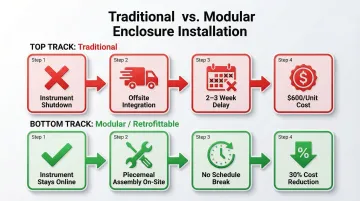
Beyond installation logistics, certification breadth was weighted heavily for sites with mixed domestic and international compliance requirements. Dual ATEX + NEC compliance (offered by R. Stahl and Adalet) simplifies procurement for multinational operators, while IP 66 combined with T6 hazardous area rating (available from Terrapin Industrial and Pepperl+Fuchs) addresses the most demanding classified environments.
Conclusion
The right instrument enclosure manufacturer for power generation must demonstrate proven performance across high-temperature, freeze-prone, hazardous, and corrosive environments — while fitting the plant's compliance framework and maintenance philosophy. A supplier's track record, certification breadth, and field serviceability drive up or down your replacement frequency and total lifecycle cost.
When comparing suppliers, evaluate on these lifecycle factors:
- Installation speed — modular designs that install in stages reduce project schedule risk
- Part replaceability — individually replaceable components eliminate full-assembly swap-outs
- Heater system longevity — heater cables rated for 30-year life expectancy versus 5 years for traditional finned/block heaters cut recurring maintenance in hazardous areas
- Serviceability without downtime — the ability to access instruments and tubing without taking them offline reduces unplanned outages and compliance exposure
Terrapin Industrial's ThermaGuard system is built specifically for these requirements — a modular, retrofittable enclosure that installs in stages, cuts installation costs by 30%, and never requires instruments to go offline. Contact the Terrapin team at (281)-615-1429 to discuss your application.
Frequently Asked Questions
What certifications should instrument enclosures have for power generation applications?
Power generation enclosures typically require IP 65/66, NEMA 4/4X for outdoor or corrosive environments, and NEMA 7/9 for hazardous locations. Facilities with classified areas need ATEX/IECEx or NEC Division ratings matched to their zone. Heated enclosures in those areas must also carry a temperature class (T4 or T6) to keep surface temperatures below gas auto-ignition thresholds.
What is the difference between NEMA and IP ratings for instrument enclosures?
NEMA ratings (per NEMA 250) go beyond ingress protection to cover corrosion resistance, external ice formation, and gasket aging — criteria that IEC 60529 IP ratings don't address. While NEMA 4X broadly corresponds to IP66 for ingress protection, the two are not equivalent: NEMA 4X enclosures must pass additional mechanical tests that IP66 enclosures may not, according to Saginaw Control's ratings comparison guide.
How do heated instrument enclosures maintain temperature in cold-climate power plants?
Heated enclosures use electric heater cables, finned heaters, or block heaters to keep internal temperatures above process fluid freezing points and electronics operating minimums. Newer heater cable systems, such as Terrapin Industrial's heated liner, can last up to 30 years compared to roughly 5 years for traditional finned or block heaters, which commonly fail due to single-use thermal fuses.
Can instrument enclosures be used in hazardous classified areas at power plants?
Yes, enclosures used in NEC Division 1/2 or ATEX Zone 1/2 areas must be specifically certified for those classifications. Common approaches include explosion-proof (Ex d), purged/pressurized, and increased safety (Ex e) designs. The enclosure's temperature class (T1-T6) must be compatible with the gas or vapor group present, ensuring surface temperatures remain below auto-ignition thresholds.
What materials are commonly used in instrument enclosures for power generation environments?
Mild steel is cost-effective for standard environments, while 316L stainless steel handles corrosive or washdown conditions. Aluminum offers lightweight, non-sparking properties for hazardous areas. GRP (glass-reinforced polyester) excels in corrosive, offshore, or marine environments, withstanding temperatures down to -60°C without the weight or cost of metal. Material choice should align with ambient environment, corrosion exposure, and maintenance requirements.
What is a retrofittable instrument enclosure and when is it needed?
A retrofittable enclosure can be installed or replaced around an existing in-service instrument without taking it offline — critical in power generation where shutting down measurement points requires permits, process interruptions, or outage windows. Terrapin Industrial's patented modular design addresses this challenge by allowing piecemeal installation around live instruments, eliminating downtime and reducing installation costs by 30%.