Introduction
In oil & gas, petrochemical, and chemical manufacturing, instrument enclosures aren't just protective hardware—they're critical safety infrastructure that must perform reliably in environments with explosive gases, extreme temperatures, and corrosive conditions. The wrong manufacturer creates compliance failures, costly downtime, and safety incidents that ripple through an entire project. Choosing well cuts installation time, eliminates schedule delays, and extends equipment service life by years.
The hazardous area equipment market is projected to grow from USD 8.23 billion in 2024 to USD 11.28 billion by 2030, driven by expanding industrial activity, stricter regulatory frameworks (NEC, ATEX, IECEx), and growing adoption of field instrumentation in classified areas. Within this landscape, the junction boxes and enclosures segment commands 26.3% market share. This guide breaks down 10 manufacturers worth evaluating — what they make, where they excel, and what differentiates them in hazardous area applications.
Key Takeaways
- Instrument enclosures for hazardous areas must meet zone/division classifications and carry certifications such as ATEX, IECEx, or UL/CSA
- Manufacturers span global automation conglomerates, enclosure specialists, and modular solution providers — each suited to different project scales
- Evaluate manufacturers on certification coverage, enclosure material, protection method (Ex d, Ex p, Ex e), and maintenance accessibility
- Modular and retrofittable designs cut installation time and costs compared to traditional rigid enclosures
- OSHA penalties for willful safety violations can reach up to $165,514 per violation, making certification a hard requirement, not a recommendation
What Are Industrial Instrument Enclosures for Hazardous Areas?
Instrument enclosures are protective housings built for one core purpose: keeping field instruments—pressure transmitters, flow meters, temperature sensors, analyzers—safe in dangerous environments. They work in two directions, shielding instruments from hazardous atmospheres outside while also preventing any internal sparks or heat from reaching the surrounding flammable gases or dust.
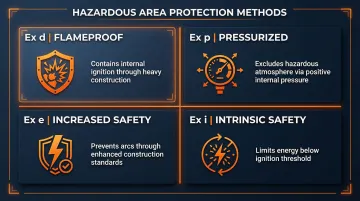
Two protection philosophies govern enclosure design, each addressing the hazard differently:
- Ex d (Flameproof/Explosion-Proof): Enclosures built to withstand internal explosions and contain flame paths — compliant with the ATEX Directive 2014/34/EU for European markets
- Ex p (Pressurized/Purged): Maintains positive-pressure protective gas inside to exclude hazardous atmosphere entirely
- Ex e (Increased Safety): Prevents arcs and sparks through enhanced construction standards rather than containment
- Ex i (Intrinsic Safety): Limits electrical and thermal energy below the threshold needed to ignite surrounding gases
Classification Systems
Which classification system applies depends on where the installation sits geographically. North American facilities follow the NEC Class/Division system; most international and export projects use the IEC Zone system.
NEC Class/Division (North America):
- Class I Division 1: Flammable gases present continuously or under normal operations
- Class I Division 2: Gases present only under abnormal conditions
IEC Zone System (International):
- Zone 0/1: Explosive atmosphere present continuously or likely during normal operation
- Zone 2: Explosive atmosphere unlikely or exists briefly
Understanding these classifications is the first step — because the manufacturer you choose needs to certify their enclosures against the specific system your facility requires, whether that's NEC, ATEX, IECEx, or a combination of all three.
Top 10 Industrial Instrument Enclosure Manufacturers for Hazardous Areas
Manufacturers on this list were evaluated against four criteria:
- Hazardous area certification breadth (ATEX, IECEx, NEC)
- Enclosure design innovation and modularity
- Industry track record across oil & gas, petrochemical, and power sectors
- Ability to reduce total installed cost or operational disruption
Terrapin Industrial
Texas-based manufacturer founded by industry professionals with direct field experience, Terrapin addresses a persistent operational pain point: the need to take instruments offline during enclosure replacement or installation, which causes costly schedule delays.
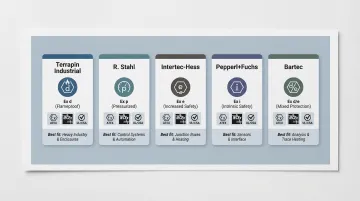
Key Differentiator: The only manufacturer offering a fully retrofittable, modular enclosure that can be installed in stages around live instruments without process interruption—reducing total installation cost by 30% and heater installation time by 60%.
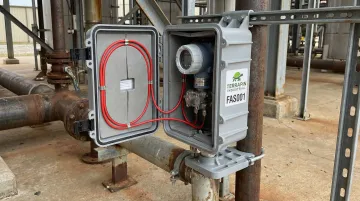
The patented ThermaGuard Retrofittable Enclosure (FAS001) features a modular design installable around operational instruments without downtime. The patent-pending heated liner offers 30-year service life with 108-720W output options and T6 hazardous area rating, compared to traditional finned heaters limited to T3 applications with typical 5-year lifespans.
Product Portfolio:
| Feature | Specification |
|---|---|
| Key Products | ThermaGuard Retrofittable Enclosure (IP66), Expandable Enclosures (IP65), heated liner with 108-720W output options |
| Certifications | IP66, IP65; heated liner rated for T6 hazardous areas; pre-engineered for NEC Class/Division compliance |
| Best For | Oil & gas, petrochemical, power generation requiring enclosure replacement or new installation without instrument downtime |
The ThermaGuard system delivers several installation advantages over conventional enclosures:
- Eliminates finned heaters, GUATs, and rigid conduit via integrated heater cable design
- Self-aligning manifold includes pre-engineered holes for conduit and tubing bundles
- Quick-connect pipe stand bracket allows enclosure removal without disrupting instrument operation
R. Stahl AG
German specialist in hazardous area technology with decades of experience, R. Stahl manufactures modular barrier systems, control panels, and custom enclosures specifically engineered for Zone 1 and Zone 2 classified environments.
Key Differentiator: Deep certification expertise (ATEX, IECEx, NEC), highly modular product philosophy, and close collaboration with certification bodies offering turnkey compliance solutions for complex regulatory environments.
Product Portfolio:
| Feature | Specification |
|---|---|
| Key Products | Series 8265 (Ex d aluminum), Series 8280 EXpressure (lightweight Ex d), Series 8146 (Ex e GRP), Series 8150 (Ex e stainless steel) |
| Certifications | ATEX, IECEx, NEC, CE Code |
| Best For | Petrochemical, pharmaceutical, offshore platforms requiring internationally certified custom enclosures |
The Series 8265 Ex d enclosures are certified for global use including NEC applications, while the Series 8280 EXpressure technology enables lighter weight designs compared to traditional flameproof enclosures.
Intertec-Hess GmbH
German manufacturer specializing in GRP (glass-reinforced polyester) composite protective enclosures for field instrumentation in extreme environments. Intertec's Ex p pressurized cabinets are certified for Zone 1 and Zone 2.
Key Differentiator: GRP composite construction offers corrosion resistance comparable to stainless steel at approximately 75% less weight, making Intertec enclosures well-suited to offshore platforms where weight reduction is critical.
Product Portfolio:
| Feature | Specification |
|---|---|
| Key Products | MULTIBOX, DIABOX, UNIBOX protective enclosures; CLASSIC and ARCTIC SHELTER cabinets; SAFE LINK pre-assembled field instrumentation solution |
| Certifications | PTB-certified Ex p; ATEX; IECEx |
| Best For | Offshore, refinery, and process analyzer applications requiring lightweight, corrosion-resistant, thermally insulated housings |
The SAFE LINK turnkey service provides pre-assembled field instrumentation hookups to reduce installation time and cost—a significant differentiator for complex offshore projects.
Pepperl+Fuchs
Global leader in industrial sensors and intrinsic safety technology, Pepperl+Fuchs manufactures intrinsically safe barriers, field enclosures, and remote I/O systems designed for tight integration with field instruments in Zone 0, Zone 1, and Zone 2 hazardous areas.
Key Differentiator: Miniaturized sensor technology, extensive R&D investment, and products optimized for digitalized production environments. The standout strength is Ex i (intrinsic safety) protection for transmitters and analyzers in process-critical applications.
Product Portfolio:
| Feature | Specification |
|---|---|
| Key Products | GR.T* Series (GRP terminal/junction boxes), SR.T* Series (stainless steel), Zener barriers, galvanic isolators, remote I/O field enclosures |
| Certifications | ATEX, IECEx, UL, CSA, FM |
| Best For | Process industries requiring intrinsically safe field instruments, digital factory integration, pharmaceutical and fine chemical plants |
The GR.T* Series offers Ex e, Ex i, and Ex tb certification with coverage for Zone 1, Zone 2, Zone 21, and Zone 22 applications.
Bartec GmbH
German explosion protection specialist offering one of the broadest product portfolios in the hazardous area market—from enclosures and control stations to motors and mobile devices. Bartec serves energy, mining, and process industries with customized engineering and end-to-end compliance solutions.
Key Differentiator: Strong regional standards expertise (ATEX for European markets, IECEx for global deployment) and the ability to combine bespoke engineering with certified compliance makes Bartec a preferred partner for multi-site international projects.
Product Portfolio:
| Feature | Specification |
|---|---|
| Key Products | EJBX Series (Ex d IIB+H2 stainless steel), EJB-UL Series (aluminum explosion-proof with UL), EJC Series (aluminum Ex d IIC), custom control panels |
| Certifications | ATEX, IECEx, CSA, UL, INMETRO |
| Best For | Multi-national projects in oil & gas, mining, and process industries needing diverse protection methods under a single supplier |
Bartec's end-to-end hazardous area engineering includes custom control panels and system integration, with enclosures like the EJB-UL carrying ATEX, IECEx, and UL certifications to enable global standardization.
Eaton Corporation
US-based multinational with a broad portfolio of hazardous area enclosures, switchgear, and lighting. Eaton's Crouse-Hinds series is widely recognized in North American oil & gas and petrochemical markets for NEC-compliant explosion-proof and dust-ignition-proof enclosures.
Key Differentiator: Full NEC Class I/II/III Division 1 and 2 product coverage backed by a global distribution network—one of the broadest stocking footprints available for North American plant builds and maintenance programs.
Product Portfolio:
| Feature | Specification |
|---|---|
| Key Products | Crouse-Hinds EJB Series (Class I/II Div 1), GUB Series (instrument enclosures for Div 1 & 2), GUBA Series (IECEx certified for Zones 1/2) |
| Certifications | UL, CSA, ATEX, IECEx |
| Best For | North American industrial facilities, utilities, and petrochemical plants requiring NEC Class/Division compliant instrument housings |
Note: Eaton's B-Line series focuses on cable management systems (trays, ladders), distinct from the Crouse-Hinds instrument enclosure portfolio.
Emerson Electric
Global leader in process automation and field instrumentation. Emerson's Appleton brand manufactures explosion-proof enclosures, conduit systems, and control panels for hazardous locations, complementing Emerson's broader instrumentation portfolio.
Key Differentiator: When instrument enclosures must work directly with Emerson's DeltaV, Rosemount, or Fisher field devices, Appleton provides a single-source solution that removes compatibility risk from the procurement process.
Product Portfolio:
| Feature | Specification |
|---|---|
| Key Products | Appleton explosion-proof conduit bodies, junction boxes, instrument enclosures; hazardous location junction boxes |
| Certifications | UL, CSA, ATEX, IECEx |
| Best For | Oil & gas, chemical processing, and power generation sites with existing Emerson instrumentation ecosystems |
Honeywell
US multinational offering explosion-proof enclosures and smart safety controls as part of an integrated industrial safety platform. Honeywell's Zone 1/21 IO System represents an intrinsically safe remote I/O system designed for direct installation in Zone 1/21 hazardous areas.
Key Differentiator: Ability to combine hardware enclosures with real-time diagnostics and multi-regional regulatory expertise. Tight integration with Honeywell Experion PKS (DCS) and Safety Manager (SIS) offers unified architecture for process control and safety.
Product Portfolio:
| Feature | Specification |
|---|---|
| Key Products | Zone 1/21 IO System (intrinsically safe remote I/O), explosion-proof instrument housings, integrated safety system panels, Enraf tank gauging accessories |
| Certifications | UL, CSA, ATEX, IECEx, SIL 3 (Safety Manager) |
| Best For | Large-scale oil & gas, refinery, and LNG projects requiring enclosure integration with safety instrumented systems |
ABB Ltd
Swiss-Swedish multinational with deep automation and power systems expertise. ABB manufactures explosion-proof and increased safety enclosures for hazardous locations, often specified in conjunction with ABB instrumentation and control systems on major industrial projects globally.
Key Differentiator: Ability to deliver complete automation solutions—from field instrument to control room—with consistent global certification coverage across ATEX, IECEx, and NEC standards.
Product Portfolio:
| Feature | Specification |
|---|---|
| Key Products | Ex d and Ex e enclosures, junction boxes, Ex-rated marshalling panels, JDF200 Field Indicator (Ex d / Ex i certified) |
| Certifications | ATEX, IECEx, UL, CSA, EAC, INMETRO |
| Best For | International EPC projects requiring integrated instrument enclosures with ABB automation platforms |
ABB products cover Groups I (mining) and II, Zones 1, 2, 21, 22, and Class I Div 1 & 2.
nVent (HOFFMAN)
US-based enclosure manufacturer—through the HOFFMAN brand, nVent produces a range of industrial enclosures including hazardous location-rated products certified for NEC Class I Division 2 and Zone 2 environments, widely used across North American manufacturing, oil & gas, and power generation.
Key Differentiator: Extensive standard product availability, short lead times, and large North American distribution network—making nVent HOFFMAN a practical choice for maintenance replacements and standardized plant builds.
Product Portfolio:
| Feature | Specification |
|---|---|
| Key Products | HOFFMAN ZonEx Enclosures (Ex e for Zone 1/2), purge & pressurization systems (Type Y, Z, X for Class I Div 1/2), stainless steel and fiberglass options |
| Certifications | ATEX, IECEx, cUL Type 4/4X, AEx |
| Best For | North American facilities needing readily available, cost-competitive enclosures for Div 2/Zone 2 instrument protection |
The ZonEx line focuses primarily on Ex e (increased safety) applications, with purge and pressurization systems enabling general-purpose enclosures to be used in Class I Division 1/2 environments.
How We Chose These Manufacturers
Selection was based on three critical factors:
- Certification breadth across ATEX, IECEx, UL, and CSA — enabling deployment across regulatory jurisdictions without separate product lines
- Specialization in instrument enclosures, not general electrical boxes, with design features specific to transmitters, analyzers, and process sensors
- Proven track record in oil & gas, petrochemical, and offshore — industries where equipment failure carries catastrophic consequences
Those criteria also reflect where buyers most often go wrong. Here are the mistakes that consistently drive up cost and schedule risk.
Common Buyer Mistakes
Brand Familiarity Over Certification Verification: Choosing manufacturers based on name recognition without verifying that specific product lines carry the required zone/division and temperature class certifications for the application.
Ignoring Total Installed Cost: Purchase price is only part of the equation. Traditional rigid enclosures can require 20+ field man-hours per transmitter, and offsite integration runs roughly $600 per unit — plus 2-3 week schedule breaks.
Maintenance Accessibility Oversight: Not all enclosures allow instrument replacement without full decommissioning. For retrofit scenarios where taking instruments offline creates operational or safety risk, modular designs offer a clear advantage worth weighing against initial cost.
Conclusion
The best instrument enclosure manufacturer for a hazardous area project is the one whose products align with your specific zone/division classification, environmental conditions, instrument types, and total lifecycle cost — not necessarily the largest brand name in the catalog.
Procurement and engineering teams should evaluate manufacturers on:
- Installation complexity and field labor requirements
- Certification currency and temperature class coverage
- Maintenance accessibility and retrofittability
- How enclosure design integrates with planned and reactive maintenance workflows
- Total installed cost including integration, downtime, and long-term maintenance
Those criteria point directly to enclosure design decisions — and that's where modular architecture makes a measurable difference. For facilities in oil & gas, petrochemical, or power generation, Terrapin Industrial's patented modular enclosures reduce total installation cost by 30%, eliminate offsite integration delays, and support retrofittable replacement without taking instruments offline. Contact Terrapin at (281)-615-1429 to discuss your project requirements.
Frequently Asked Questions
Frequently Asked Questions
What certifications are required for instrument enclosures in hazardous areas?
North American applications require UL/CSA listings and NEC Class/Division compliance, while international and export projects require ATEX (EU) or IECEx certifications. The temperature class (T-rating) must match the ignition temperature of gases present in the area (for example, T6-rated equipment has a maximum surface temperature of 85°C).
What is the difference between Class I Division 1 and Division 2 instrument enclosures?
Division 1 areas have flammable gases present under normal operating conditions and require fully explosion-proof housings (Ex d). Division 2 areas have gases present only under abnormal conditions, allowing for less stringent protection methods such as increased safety (Ex e) or non-incendive designs.
What does IP66 mean for an instrument enclosure?
IP66 indicates the enclosure is fully dust-tight and protected against powerful water jets from any direction. This makes it suitable for outdoor industrial environments subject to washdowns, heavy rain, or high-pressure cleaning—common in petrochemical and offshore applications.
What is the difference between explosion-proof (Ex d) and pressurized (Ex p) enclosures?
Ex d (flameproof) enclosures contain any internal ignition through heavy-duty construction and controlled flame paths. Ex p (pressurized/purged) enclosures maintain slight positive internal pressure with inert gas or clean air, excluding the hazardous atmosphere from the enclosure interior entirely.
Can standard (non-Ex rated) instruments be installed inside a hazardous area enclosure?
Ex p (pressurized) enclosures allow non-Ex rated instruments to be installed inside Zone 1 or Zone 2 areas by excluding the hazardous atmosphere from the enclosure interior. The purge and pressurization system must be correctly specified and certified for the specific application.
How can instrument enclosures be replaced or maintained without shutting down the process?
Traditional rigid enclosures require instruments to be taken offline for replacement, causing process interruptions. Modular designs like Terrapin Industrial's ThermaGuard system install or remove in sections around live instruments, eliminating process shutdowns and cutting maintenance downtime.