Introduction
In oil & gas and petrochemical facilities, the cost of instrument enclosure failure extends far beyond the replacement part. Unplanned downtime costs oil and gas companies an average of $42 million annually, with bottom-tier performers facing costs up to $88 million per year. Between 2006 and 2017, U.S. refineries experienced 1,700 shutdowns, with 46% caused by mechanical breakdowns—many traced to component failures in instrument systems.
The culprits are often the smallest components. A degraded gasket. A misrated cable gland. A failed heating element. These trigger disproportionate consequences: unplanned shutdowns, safety incidents, and emergency repairs that dwarf the cost of the part itself. Every 10°C rise in enclosure temperature cuts electronic component lifespan roughly in half—making thermal accessory selection a direct reliability variable, not an afterthought.
This guide covers:
- The major categories of electrical enclosure accessories
- How each contributes to system performance and safety
- Selection criteria for demanding and hazardous environments
- What modern modular designs are changing about accessory integration
TLDR:
- Accessories determine whether an enclosure performs as specified—a single non-compliant component downgrades the entire system rating
- Temperature excursions cut electronic component lifespan in half for every 10°C rise; Arctic operations require protection to -60°C
- Heated liner technology extends heater life from 5 years to 30 years—and installs in under 2 minutes
- Modular enclosure systems reduce total installation costs by 30% and allow accessory replacement without taking instruments offline
What Are Electrical Enclosure Accessories?
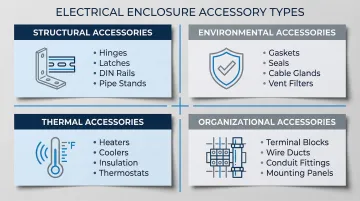
Electrical enclosure accessories are the components—beyond the enclosure body itself—that enable a housing to fulfill its protective, functional, and compliance requirements. These fall into four categories:
- Structural accessories: Hinges, latches, mounting brackets, DIN rails, pipe stands
- Environmental accessories: Gaskets, seals, cable glands, vent filters
- Thermal accessories: Heaters, coolers, insulation, thermostats
- Organizational accessories: Terminal blocks, wire ducts, conduit fittings
Why Accessories Are Not Afterthoughts
An enclosure rated IP 66 can lose that rating if a single cable gland is improperly installed or a gasket degrades. That gap between lab rating and field performance is exactly what the regulatory framework addresses.
Regulatory Context: Assembly-Level Ratings
Ingress protection ratings apply to the fully assembled unit — not the enclosure shell alone. Three major standards make this explicit:
- IEC 60529 requires that the complete assembly, including all cable entries and seals, maintains the rated protection level
- NEMA 250 specifies that openings in a Type 4 enclosure may only accept components rated Type 4, 4X, 6, or 6P to retain that rating
- UL and CSA treat a single water drop entering during testing as a watertight failure
The practical consequence: installing an IP54 cable gland on an IP66 enclosure downgrades the entire system to IP54, eliminating protection against high-pressure water jets.
Key Categories of Electrical Enclosure Accessories
Each accessory category addresses a distinct performance risk. The following sections break these down by function.
Mounting and Structural Hardware
Mounting accessories determine how securely instruments and components sit inside the enclosure. The core hardware types include:
- DIN rails for standardized component attachment
- Back panels and sub-panels for structured internal layout
- Pipe stand brackets for field-mounting to process piping
- Quick-connect systems for rapid component swap-out
The right selection affects both vibration resistance and how fast components can be swapped during maintenance.
In high-vibration environments like offshore platforms and compressor stations, mounting hardware selection is critical to preventing component fatigue. Traditional rigid installations require upwards of 20 field man-hours per transmitter. Modern modular systems with quick-connect pipe stand brackets cut that figure by 30%.
Terrapin Industrial's ThermaGuard system features a patented quick-connect design with an integrated pipe stand bracket that mounts to Schedule 40 2" pipe diameter. The self-aligning manifold provides standardized ports for conduit and tubing bundle installation, reducing total installation time and cost by 30%.
Cable Entry and Management Accessories
Cable glands, conduit fittings, strain relief connectors, and wire ducts protect against one of the most common ingress failure points. IEC 62444 is the international standard governing cable glands, establishing requirements for sealing, retention, and mechanical strength.
To meet minimum standards, cable glands must provide at least IP54 protection, though IP66/68 ratings are standard for industrial applications. IEC 62444 mandates that glands must prevent cable pulling or twisting forces from being transmitted to conductor terminations, a leading cause of connection failure in the field.
Pre-engineered, standardized entry points for power wiring, control wiring, and process tubes reduce installation errors and maintain rating integrity. Terrapin's ThermaGuard manifold features pre-engineered holes for these connections, with all penetrations sealed using entry seals and cold shrink caps to maintain IP65/IP66 protection.
Sealing and Weatherproofing Components
Door gaskets, compression seals, and vent filters form the primary defense against environmental ingress. Gasket material selection must match the chemical and temperature exposure of the environment—a gasket rated for indoor use will fail rapidly in marine or chemical plant settings.
| Material | Operating Temp Range | Key Resistance Properties | Typical Application |
|---|---|---|---|
| Neoprene (CR) | -35°C to +90°C | Good ozone, weathering, and aging resistance; moderate oil resistance | General purpose industrial enclosures |
| EPDM | -45°C to +150°C | Excellent ozone, steam, acid, and alkali resistance; poor oil/petrol resistance | Outdoor weathering; hot water applications |
| Silicone (VMQ) | -50°C to +175°C | Superior heat resistance and cold flexibility; excellent UV/ozone stability | Extreme temperature environments; hygienic wash-down zones |
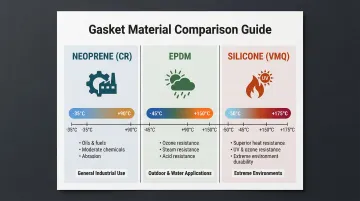
Gasket degradation is measured by compression set (ASTM D395 Method B), which indicates a material's ability to recover its original thickness after sustained compression. Lower percentages mean better durability and longer seal life. Terrapin Industrial uses EPDM or Neoprene gaskets in their enclosures, selected for their durability in harsh industrial environments.
Security and Access Control Hardware
Locking mechanisms, tamper-proof fasteners, padlock hasps, and key-coded locks prevent unauthorized access. In facilities with hazardous area classifications, unauthorized access to instrument enclosures presents both safety and compliance risks.
Critical applications rely on multi-point locking systems where a basic padlock is insufficient. These systems engage at multiple points around the enclosure perimeter, distributing force and resisting prying. For facilities requiring certified ingress protection, enclosures with IP65 or IP66 ratings provide an additional layer of physical integrity alongside mechanical locking hardware.
Thermal Management Accessories for Industrial Environments
Electronic instruments have narrow operating temperature windows. Push them outside those windows—through arctic cold or desert heat—and failures follow quickly, often at the worst possible moment.
The Cost of Temperature Excursion
Temperature extremes are a primary driver of electronic failure. The life expectancy of electronic components is cut in half for every 10°C (18°F) rise above their rated operating temperature. In Arctic operations—Northern Canada, Alaska—ambient temperatures can drop to -60°C (-76°F). Without adequate heating, instruments suffer from freezing, LCD screen failure, and battery drainage.
In oil and gas flowlines, low temperatures cause hydrate formation (ice-like crystals), leading to blockages and equipment damage. The financial impact is severe: facilities experiencing temperature-related failures face not just equipment replacement costs but production losses during extended shutdowns.
Traditional Heating Approaches and Their Limitations
The traditional approach uses finned strip heaters, GUAT (General Unit Air Thermostat) systems, and rigid conduit-routed heat trace. These systems have significant limitations:
- Short service life: Classic finned and block-style heaters typically fail within 5 years due to single-use thermal fuses
- Space consumption: Finned heaters and rigid conduit occupy significant interior space, reducing access to instruments
- Installation complexity: Rigid conduit routing requires extensive field labor and specialized skills
Modern Heated Enclosure Liner Technology
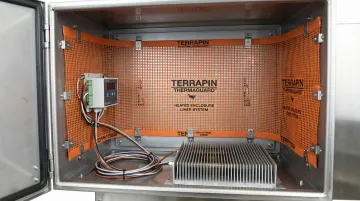
Heated enclosure liner technology takes a different approach: a liner fitted inside the enclosure uses heater cable instead of bulky finned elements, eliminating rigid conduit and freeing up interior space for instruments and tubing.
Terrapin Industrial's patent-pending heated enclosure liner is built around this design. Key specifications include:
- 30-year heater cable life expectancy — six times longer than traditional finned heaters
- T6 hazardous area rating — the most restrictive class, limiting surface temperature to 85°C (vs. T3 at 200°C for traditional heaters)
- 108W to 720W heat output depending on heater cable selection (3 to 20 watts/ft)
- Maintains >75°F (23.9°C) internally in ambient conditions as low as -60°F (-51.1°C)
- Under 2-minute installation using a patented universal mounting bracket with 360° rotational positioning
Cooling Accessories for Hot Climates
Heating addresses cold-side risk. On the opposite end, high-ambient environments require active cooling to keep instruments within their rated range. Options include:
- Air conditioners: For high heat loads in sealed enclosures
- Heat exchangers: Air-to-water or air-to-air designs for moderate cooling needs
- Vortex coolers: Compressed air-driven cooling for hazardous areas
- Thermoelectric coolers: Solid-state cooling for compact applications
Selection depends on heat load calculation based on IEC 60890. The required cooling capacity is:
Qc = Qv - (k × A × ΔT)
Where Qv is internal heat loss, A is surface area, k is the heat transfer coefficient, and ΔT is the temperature difference.
Sealed vs. ventilated cooling: Closed-loop cooling is required when ambient air is dirty, corrosive, or humid, or when ambient temperature exceeds the desired internal temperature. Open-loop ventilation with filter fans works only when ambient air is cool and clean—it cannot cool below ambient temperature.
Terrapin Industrial offers Class 1 Division 2 thermoelectric coolers that integrate with their ThermaGuard expandable enclosure systems as plug-and-play bolt-on accessories.
Thermostat and Temperature Sensor Integration
Heating and cooling hardware only performs as well as the controls behind it. Thermostats, RTDs, and temperature controllers work together to:
- Maintain set-point temperatures without manual intervention
- Reduce energy consumption by cycling heating/cooling based on actual conditions
- Trigger alarm outputs when temperatures exceed defined limits
Terrapin supplies preset thermostats that integrate directly with their 100W heaters and heated liner systems—a matched control solution for extreme cold environments that doesn't require separate sourcing or field calibration.
How to Select the Right Accessories for Your Application
Environmental Classification: IP and NEMA Ratings
Map IP and NEMA ratings to the application environment—indoor/outdoor, washdown, submersion risk, corrosive atmosphere—and ensure every accessory installed is rated to at least the same protection level as the enclosure itself.
| Rating | Protection Level | Nozzle Diameter | Water Flow | Distance | Duration |
|---|---|---|---|---|---|
| IP65 | Water Jets | 6.3 mm | 12.5 L/min | 2.5-3 m | >3 min |
| IP66 | Powerful Water Jets | 12.5 mm | 100 L/min | 2.5-3 m | >3 min |
IP65 and IP66 are common thresholds for outdoor industrial applications. Installing an accessory rated below the enclosure's level downgrades the entire system to the lowest rating.
Hazardous Area Requirements
In areas classified for explosive atmospheres—oil & gas production sites, refineries, chemical plants—accessories must be rated and certified for the appropriate zone or division and temperature class.
T-class ratings (T1–T6) define the maximum surface temperature a heater can generate. T6 is the most restrictive class, limiting surface temperature to 85°C, ensuring safety in atmospheres with low ignition temperatures.
| T-Class | Max Surface Temp |
|---|---|
| T1 | 450°C |
| T2 | 300°C |
| T3 | 200°C |
| T4 | 135°C |
| T5 | 100°C |
| T6 | 85°C |
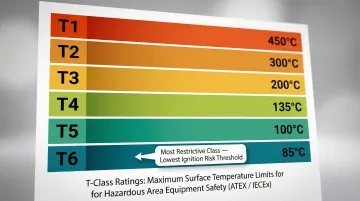
Heating accessories in Class I, Division 1 areas must not exceed 80% of the autoignition temperature of the surrounding gas or vapor, per NEC (NFPA 70) Articles 500, 501, and 505.
Material Compatibility
Enclosure accessory materials—steel, stainless steel, aluminum, plastic components—must be matched to the chemical environment. ISO 12944 classifies environments from C1 to CX (extreme).
- C3 (Medium): Urban/industrial atmospheres
- C4 (High): Industrial and coastal areas with moderate salinity
- C5 (Very High): Aggressive industrial atmospheres, high humidity, coastal areas
- CX (Extreme): Offshore areas with high salinity
In marine, offshore, and coastal chemical facilities, standard carbon steel hardware corrodes rapidly. Stainless steel 316 grade is recommended for C5 and CX environments due to its resistance to chlorides. For CX-rated sites specifically, non-metallic mounting options — such as fiberglass pipe stands — eliminate corrosion risk at the support structure level, which is where hardware failures often start. Terrapin Industrial's enclosure hardware and pipe stand options are designed with these material requirements in mind.
Total Cost of Ownership
The cheapest accessory at purchase is often the most expensive over a 10-year service life. Base selection decisions on replacement frequency, maintenance labor, and downtime risk.
The difference between a 5-year and a 30-year heater life expectancy isn't just a product spec — it's a maintenance schedule, a labor budget, and an instrument downtime risk. Key cost drivers to evaluate:
- Replacement frequency: A heater replaced every 5 years costs 6x more in parts alone over 30 years than one rated for the full service life
- Downtime exposure: Replacements requiring instruments to go offline add indirect costs beyond the part itself
- Scale multiplier: At 500+ enclosures, switching to longer-life heater accessories can eliminate hundreds of thousands of dollars in cumulative lifecycle spend
Common Mistakes to Avoid When Configuring Enclosure Accessories
Mismatched Ratings
Installers sometimes pair an IP 66-rated enclosure with a cable gland or accessory rated only to IP 54, unknowingly downgrading the entire installation's protection level. The weakest-rated component defines the protection level of the whole assembly.
Every accessory — gaskets, cable glands, conduit fittings, vent filters — must match or exceed the enclosure's rated IP level. This applies to replacement parts as well: substituting a lower-rated component during maintenance compromises the entire system.
Skipping Thermal Load Calculations
Installers who specify heaters based on "what was used before" rather than calculating actual heat load risk under-heating (instrument failure) or over-heating (accelerated component degradation).
Heat load calculation accounts for enclosure volume, insulation, ambient temperature, and instrument heat dissipation. Calculating the thermal accessory selection from first principles ensures instruments stay within operating temperature ranges under all conditions.
Ignoring Gasket Degradation
Gaskets harden, crack, and compress over time — especially under UV exposure and chemical contact. Many ingress failures in the field are traced to gaskets that were never inspected after initial installation.
Incorporate gasket inspection into scheduled maintenance intervals. A few minutes of visual checks can prevent unplanned downtime and equipment damage. A simple proactive approach:
- Inspect for cracking, hardening, or compression at each scheduled maintenance visit
- Replace gaskets based on material specifications and environmental exposure history
- Document gasket condition and replacement dates to track degradation patterns
Modular Enclosure Systems: Rethinking How Accessories Are Integrated
The Traditional Problem
In conventional rigid enclosure installations, integrating accessories—heaters, cable entries, mounting hardware—typically requires offsite integration. The enclosure must be built out in a shop before transport to the field, or the instrument must be taken offline for modification.
This creates schedule delays (typically 2–3 week construction breaks), increases labor costs (approximately $600 per unit for offsite integration), and forces production shutdowns during maintenance. On the field side, traditional transmitter, manifold, and bundle installations can require upwards of 20 man-hours per transmitter.
Modular Design Advantages
Modular enclosure design addresses this through pre-engineered accessory entry points, quick-connect mounting systems, and removable component designs. Accessories can be installed, replaced, or reconfigured without taking the instrument offline — and the schedule impact is measurable. Industry surveys indicate modular construction reduces project schedules by four weeks or more for 35% of firms and lowers total project costs by approximately 7% through shorter construction periods, reduced waste, and improved safety.
Terrapin Industrial's retrofittable modular enclosure design features:
- Pre-engineered holes for power wiring, control wiring, and process tubes
- Self-aligning manifold design with integrated bundle, power wire, and control wire entries
- Quick-connect pipe stand bracket that allows easy enclosure removal without disrupting instrument operation
- Patented ThermaGuard system that reduces total installation cost by 30% and heater installation time to under 2 minutes
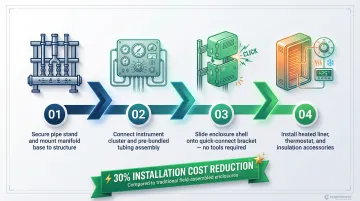
This staged approach — instruments and tubing bundles first, enclosure and thermal accessories later — reduces schedule pressure during initial construction. Individual parts can be replaced without disturbing the entire mounting assembly, keeping maintenance windows short.
Scalability for Large Facilities
For facilities managing hundreds of instrument enclosures, the cumulative impact is significant. Reduced installation labor, faster maintenance turnarounds, and eliminated offsite integration delays compound across every unit.
The ability to install in stages — shell first, then insulation, then heated liner as conditions require — gives project teams flexibility to sequence work around operational demands rather than the other way around.
Frequently Asked Questions
What is the importance of the enclosure system?
The enclosure system—including its accessories—protects sensitive instruments and electrical components from environmental hazards, physical damage, and unauthorized access while maintaining compliance with safety standards. A gap in any single component, such as a mismatched gasket or unrated cable entry, can compromise the enclosure's IP rating and expose equipment to ingress or failure.
What is the difference between attachments and enclosures?
The enclosure is the primary housing structure that contains and protects electrical components. Attachments (or accessories) are supplementary components—cable glands, heaters, gaskets, mounting hardware—added to enable specific functions or achieve the required environmental protection rating.
How do I know which IP rating I need for my enclosure accessories?
Every accessory must match or exceed the enclosure's rated IP level — if one component falls short, the whole system's rating is void. Outdoor industrial and washdown applications typically require at least IP 65; submersion-risk or high-pressure washdown environments require IP 66 or higher.
Can enclosure accessories be retrofitted without taking instruments offline?
Traditional rigid enclosure designs typically require instruments to go offline for accessory replacement. Modern modular systems—such as Terrapin Industrial's retrofittable designs with quick-connect hardware and pre-engineered entry points—allow accessories to be replaced or upgraded in the field while the instrument stays live.
What accessories are required for enclosures in hazardous areas?
In classified hazardous areas (NEC Division 1/2 or ATEX Zones), all accessories—particularly heating elements—must carry appropriate area classification ratings and temperature class certifications (e.g., T6 for the most restrictive environments). Cable entries and conduit fittings must also meet explosion-proof or increased-safety requirements.
How long do electrical enclosure heating accessories typically last?
Traditional finned and block-style heaters typically have a service life of approximately 5 years due to thermal fuse failures. Modern heater cable-based systems can achieve significantly longer lifespans—up to 30 years—reducing replacement frequency and the associated labor and downtime costs over the life of the installation.