Introduction
In oil and gas, petrochemical, and power generation facilities, climate control inside instrument enclosures is mission-critical infrastructure. When transmitters, analyzers, and valve positioners freeze, condense moisture, or drift due to thermal shock, the consequences are severe: process shutdowns, safety incidents, and six-figure emergency repairs.
A failed enclosure doesn't just mean downtime. It means lost production, regulatory scrutiny, and field technicians replacing instruments in hazardous conditions — work that proper thermal protection should have prevented entirely.
Choosing the wrong manufacturer compounds every one of those risks. Facilities end up with enclosures that can't be serviced without taking instruments offline, heaters that fail within five years, and offsite integration requirements that create 2–3 week schedule breaks.
This list focuses exclusively on manufacturers purpose-built for climate-controlled instrument enclosures — companies whose products are engineered for extreme environments, hazardous area compliance, and long-term field maintainability.
Key Takeaways
- Climate-controlled enclosures prevent freeze damage, condensation failures, and heat-related instrument drift in extreme outdoor environments
- Selection criteria include IP/NEMA ratings, hazardous area certifications (ATEX, IECEx, UL Class/Division), heater output capacity, and installation flexibility
- Manufacturers vary widely — some focus on modular retrofittable designs, others on explosion-proof systems or large-scale thermal management
- Terrapin Industrial's modular ThermaGuard design lets you install or swap enclosures without taking instruments offline — cutting total installed cost by 30%
What Are Climate-Controlled Industrial Instrument Enclosures?
Climate-controlled instrument enclosures are sealed housings equipped with integrated heating (and sometimes cooling) systems that maintain stable internal temperatures for process instruments like transmitters, analyzers, and valve positioners. These systems protect sensitive electronics from freeze damage, condensation-induced failures, and thermal drift in harsh or extreme-temperature environments.
These enclosures are essential for outdoor and exposed installations in oil and gas fields, refineries, offshore platforms, and power plants where ambient temperatures swing from extreme cold to excessive heat.
The global thermal management technologies market is projected to reach $27.75 billion by 2030, growing at a CAGR of 10.1%, and the electric heat tracing market—critical for instrument winterization—is forecast to hit $4.4 billion by 2030. That growth reflects how broadly thermal protection has become a baseline requirement across process industries, not an optional upgrade.
The manufacturers profiled below were evaluated for climate control capability, protection ratings, hazardous area suitability, and real-world installation flexibility—criteria that separate purpose-built solutions from general electrical enclosures retrofitted with aftermarket heaters.
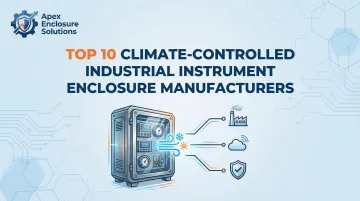
Top 10 Climate-Controlled Industrial Instrument Enclosure Manufacturers
The following manufacturers were assessed on active temperature management capability, ingress protection standards, hazardous area certifications, and installation design that minimizes downtime and lifecycle costs. Use this list to match your facility's climate demands, hazardous area classification, and installation constraints to the right solution.
Terrapin Industrial
Terrapin Industrial is a Texas-based innovator (Richwood, TX) founded by oil and gas field professionals who experienced the inefficiencies of rigid enclosure installations firsthand.
Their patented ThermaGuard modular enclosure system and patent-pending heated liner with heater cable rated for a 30-year life expectancy address the core problems that plague traditional installations: instrument downtime during enclosure replacement, offsite integration delays, and heater failures within five years.
What sets Terrapin apart:
The ThermaGuard system can be installed piecemeal around existing instruments without taking them offline or breaking the schedule. This eliminates the 2-3 week delays typical of offsite integration and the 20+ field man-hours traditionally required per transmitter replacement. The system delivers:
- 60% faster heater installation in under 2 minutes
- 30% reduction in total installed cost
- Heater output range of 108–720 watts (depending on cable selection)
- T6 hazardous area rating for the heated liner
- IP66 (Retrofittable) and IP65 (Expandable) certifications
- Maintains >75°F/23.9°C in -60°F/-51.1°C ambient environments
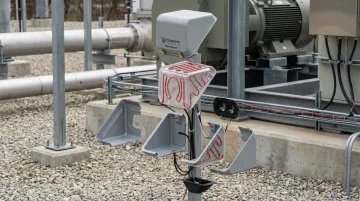
The self-aligning manifold design includes pre-engineered holes for power, control, and process tube entries, eliminating field measurement and drilling. The modular construction allows instruments to be mounted, plumbed, and calibrated in the field before the enclosure housing is installed—or retrofitted around operational instruments without shutdown.
| Key Features | Patented modular quick-connect design; pre-engineered holes for power, control, and process tube entries; self-aligning manifold; retrofittable without instrument downtime |
|---|---|
| Certifications / Standards | IP66 (Retrofittable Enclosure), IP65 (Expandable Enclosure); heated liner rated for T6 hazardous areas |
| Best For | Oil and gas, petrochemical, power generation, and offshore facilities requiring freeze protection with minimal installation downtime |
Intertec Enclosures
Intertec Enclosures (Neustadt, Germany) is a long-established manufacturer specializing in GRP (glass-reinforced polyester) and stainless steel housings with integrated heating and cooling for offshore and onshore oil and gas applications. Their product lines—including MULTIBOX, DIABOX, and THERMOTEX—are engineered for extreme climates and corrosive atmospheres.
Intertec's climate control systems include explosion-proof convection (CP), conduction, and steam heaters approved for operating temperatures between -60°C and 180°C. Their enclosures are suitable for ambient temperatures from -65°C to +65°C, with hazardous area certifications covering Gas-Ex and Dust-Ex zones 1, 2, 21, and 22 (ATEX, IECEx, CSA, EACEx).
The THERMOTEX flexible soft cover system includes optional heat tracing for freeze protection down to -60°C, making it ideal for temporary or retrofit applications where rigid enclosures aren't practical.
| Key Features | GRP and stainless steel construction; active, passive, and hybrid cooling; explosion-proof heaters; modular enclosure sizes from 20 to 277 liters |
|---|---|
| Certifications / Standards | ATEX, IECEx, CSA, EACEx for zones 1, 2, 21, 22; IP66/IP68 protection |
| Best For | Offshore platforms, remote oil and gas sites, and harsh outdoor process environments requiring corrosion-resistant materials |
nVent Hoffman
Few names carry as much recognition in industrial enclosures as nVent Hoffman (Anoka, Minnesota). Their climate-controlled product range spans heated enclosures to air-conditioned cabinets, with hazardous location heaters in 50W/80W (conductive) and 200W-600W (convection) models rated from -76°F (-60°C) to 302°F (150°C).
Their stainless steel extreme environment enclosures are rated NEMA 4X for corrosion resistance, with thermostats adjustable from 0°F to 100°F (-18°C to 38°C). Global service and parts availability make them a practical standard for large multi-site facilities.
| Key Features | Hazardous location heaters (50W-600W); touch-safe PTC heaters; semiconductor heating elements; adjustable thermostats; stainless steel construction |
|---|---|
| Certifications / Standards | ATEX, IECEx, cCSAus, IP65 (hazardous heaters), NEMA 4X (stainless enclosures) |
| Best For | Large industrial facilities needing widely available, standards-compliant climate-controlled enclosures with global parts support |
Rittal
Rittal (Herborn, Germany) offers one of the broadest climate control portfolios in the enclosure industry. Their Blue e+ cooling units deliver outputs from 1.6 kW to 5.8 kW, with hybrid technology achieving up to 75% energy savings compared to traditional systems.
Rittal's climate control solutions include IoT interfaces (Model 3124.300) that connect cooling units to energy management systems via SNMP, OPC-UA, and Modbus/TCP, enabling remote monitoring and predictive maintenance. Their RiTherm software assists with climate control planning and carbon footprint calculation—a practical differentiator for facilities with active energy reduction targets.
The systems operate across a temperature range of -20°C to +60°C, with setting ranges from +20°C to +50°C. Internal circuit protection is rated to IP55.
| Key Features | Blue e+ cooling units (1.6-5.8 kW output); IoT interface for remote monitoring; energy-efficient hybrid technology; RiTherm planning software |
|---|---|
| Certifications / Standards | UL, cUL, EAC, TÜV Nord GS; IP55 internal circuit protection |
| Best For | Process plants, industrial automation, and energy management facilities needing integrated thermal management with smart monitoring |
R. Stahl
R. Stahl (Waldenburg, Germany) specializes in explosion-proof and hazardous-area enclosures, with climate-controlled solutions for Zone 1 and Zone 2 (ATEX) and Division 1 and Division 2 (NEC) environments. Their Ex p (purge and pressurization) systems are modular and accommodate cabinets from 10 to 4,000 liters, utilizing controllers, pressure monitors, and purge valves to maintain positive pressure and prevent ingress of explosive gases.
R. Stahl's self-regulating enclosure heaters for Ex e solutions and TRANBERG® heat tracing junction boxes are designed for wall or pipe mounting in the most demanding hazardous classification environments. Their Series 8265 Ex d enclosures have global approvals including NEC, making them suitable for multinational projects.
| Key Features | Ex p pressurization systems (10-4,000 liter capacity); self-regulating heaters for Ex e; TRANBERG® heat tracing boxes; GRP and stainless construction |
|---|---|
| Certifications / Standards | ATEX, IECEx for Gas Zones 1 & 2, Dust Zones 21 & 22; compliant with IEC/EN 60079-2; NEC global approvals |
| Best For | Zone 1/Zone 2 and Division 1/Division 2 hazardous area instrument installations in chemical and oil and gas facilities |
Pepperl+Fuchs
Pepperl+Fuchs (Mannheim, Germany) is a leading field instrumentation and housing specialist serving process industries. Their field housings and instrument enclosures include options with integrated heating for cold climates and classified hazardous areas. The FH Series features copper-free aluminum Ex d IIB+H2 control panels with max power dissipation up to 260W (FH24/2 model at T4/+40°C).
The GR Series carbon-loaded GRP enclosures withstand temperatures down to -60°C, while the 5500 Series automatic purge and pressurization systems in 316 stainless steel are third-party approved for Class I, II, Div. 2 and Zone 2/22. Pepperl+Fuchs's global presence and technical support ecosystem make them a strong choice for facilities integrating field housing with transmitters and sensors.
| Key Features | FH Series Ex d IIB+H2 control panels (up to 260W); GR Series carbon-loaded GRP (-60°C rated); 5500 Series purge systems; IP66/67 protection |
|---|---|
| Certifications / Standards | Ex d IIB+H2 for Zones 1 and 2; Class I, II, Div. 2 and Zone 2/22; IP66 (GR Series), IP66/67 (EJBX Series) |
| Best For | Process industries integrating field housing with transmitters and sensors in harsh or hazardous environments |
Armorcast Products
Armorcast Products (Chatsworth, California) manufactures rugged instrument enclosures for extreme outdoor environments. Their Hot Box® line covers aluminum, fiberglass, and HDPE enclosures sized with integrated heaters for freeze protection across oil and gas pipeline, utility, and water/wastewater applications.
Armorcast's polymer concrete enclosures are noted for excellent insulating properties in cold climate installations and are resistant to UV, chemicals, and freeze/thaw cycles. Common deployments include backflow prevention assemblies, water sampling stations, and rail transit cable troughs.
| Key Features | Hot Box® heated enclosures in aluminum, fiberglass, and HDPE; polymer concrete with excellent insulation; UV, chemical, and freeze/thaw resistance |
|---|---|
| Certifications / Standards | NEMA ratings, UL listings, CSA certifications (specific ratings vary by product line) |
| Best For | North American pipeline, utility, and outdoor measurement installations requiring freeze protection in cold climates |
Hammond Manufacturing
With over a century in the North American market, Hammond Manufacturing (Guelph, Ontario, Canada) produces heated and thermostatically controlled instrument enclosures built for cold outdoor installations. Their heater product lines include FLH Series fan heaters with built-in thermostats (125W-800W), SHG Series PTC heaters (15W-150W), and SCR Series high wattage fan heaters (550W-650W).
Hammond's heaters are UL Recognized, cUL Recognized, and CE marked, with protection ratings including IP20 for most heaters and IP54/NEMA 12 for climate control units. Their strong distribution network across North America makes them accessible for facilities throughout Canada and the northern US requiring cold-climate solutions.
| Key Features | FLH, SHG, and SCR heater series (15W-800W range); mechanical and humidity/temperature thermostats; fan heaters with built-in controls |
|---|---|
| Certifications / Standards | UL Recognized, cUL Recognized, CE; NEMA 4, NEMA 4X, IP66, IP20/IP54 (varies by product) |
| Best For | Cold-climate instrument installations across Canada and the northern US in utilities, oil sands, and industrial facilities |
Adalet
Adalet (Cleveland, Ohio) is an American manufacturer focused on explosion-proof and hazardous location enclosures, including heated instrument housings for Division 1 and Division 2 classified areas in refineries, chemical plants, and offshore facilities. Their XIH / XDH Series explosion-proof instrument housings are designed to isolate power from instrumentation, with die-cast aluminum construction for OEM measurement devices.
Adalet's enclosures are UL/cUL listed for Class I, Div 1, Groups B, C, D; Class II, Div 1, Groups E, F, G, with global options including ATEX (II 2G Ex d IIB+H2) and IECEx (Ex d IIB+H2). Protection ratings include NEMA Type 4X and IP66, making them suitable for corrosive and wet environments.
| Key Features | XIH/XDH Series explosion-proof housings; back-to-back chamber design; die-cast aluminum construction; power/instrumentation isolation |
|---|---|
| Certifications / Standards | UL/cUL Class I Div 1 and 2; ATEX II 2G Ex d IIB+H2; IECEx Ex d IIB+H2; NEMA 4X; IP66 |
| Best For | Division 1 and Division 2 hazardous area instrument installations in US-based refineries and chemical plants |
Phoenix Contact
Phoenix Contact (Blomberg, Germany) integrates thermostatically controlled heating directly into instrument enclosures for outdoor process applications.
Their PTC enclosure heaters are self-regulating, ranging from 5W to 13W and operating from -49°F to 158°F (-45°C to 70°C).
Phoenix Contact offers trace heating control systems integrated into control cabinets, enabling monitoring via PLC or HMI. Their SIL 2-capable connector solutions and integration via PROFIsafe allow precise power control for safety-critical applications. Heaters are UL Recognized and CE marked, with PTC heaters rated to IP54.
| Key Features | PTC self-regulating heaters (5W-13W); trace heating control via PLC/HMI; SIL 2-capable connectors; PROFIsafe integration |
|---|---|
| Certifications / Standards | UL Recognized, CE; IP54 (PTC heaters) |
| Best For | Process automation and industrial facilities seeking integrated climate management within a broader control and automation ecosystem |
How We Chose the Top Manufacturers
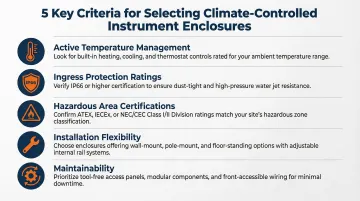
This list was built around the specific demands of climate-controlled instrument enclosures—not general electrical housing. Evaluation criteria included:
- Active temperature management capability: Heater output range, temperature delta performance, and cooling capacity
- Ingress protection ratings: IP and NEMA standards appropriate for outdoor and washdown environments
- Hazardous area certifications: ATEX, IECEx, and UL Class/Division listings for explosive atmospheres
- Installation flexibility: Modular designs, retrofittable systems, and field-customizable configurations
- Maintainability: Heater lifespan, component replaceability, and access without instrument downtime
These criteria exist because the most common procurement mistake is treating enclosure selection as a secondary decision.
Selecting a general-purpose enclosure and retrofitting a heater—without considering long-term reliability, certification compliance, or maintenance access—routinely leads to heater failures within five years or condensation issues from inadequate sealing.
In the worst cases, facilities face full instrument shutdowns just to replace an enclosure.
We also evaluated manufacturers on North American and global market relevance, parts availability, and whether their designs reduce or eliminate instrument downtime during installation or enclosure replacement — a factor that directly affects total cost of ownership. For facilities managing 500+ instrument enclosures, these decisions can mean the difference between hundreds of thousands of dollars in savings or overruns.
Conclusion
The manufacturer you select determines whether process instruments stay accurate, online, and safe across decades of operation in extreme environments. The right choice means matching thermal performance, hazardous area rating, and installation design to the specific site conditions and maintenance realities of your facility.
Procurement and engineering teams should go beyond brand recognition. The metrics that matter most at scale:
- Total installed cost, not just unit price
- Heater life expectancy (5-year versus 30-year lifespans compound fast across large sites)
- Field man-hours per installation (20 hours versus 8 hours adds up quickly)
- Whether the enclosure can be replaced without taking instruments offline
For facilities that need a modular solution that installs faster, costs less, and never requires taking instruments offline for enclosure replacement, Terrapin Industrial's ThermaGuard system was designed around those exact constraints. Contact Terrapin's team at (281) 615-1429 or (210) 219-2821 to discuss how ThermaGuard can reduce your total installed cost by 30% while delivering a 30-year heater lifespan and faster field replacement.
Frequently Asked Questions
What is a climate-controlled instrument enclosure and why is it needed in industrial settings?
Climate-controlled instrument enclosures are sealed housings with integrated heating (or cooling) that maintain stable internal temperatures for sensitive process instruments—such as transmitters and analyzers. They protect against freeze damage, condensation, and heat-related measurement drift in outdoor or extreme-environment installations.
What temperature can a heated instrument enclosure maintain in extreme cold environments?
Performance varies by manufacturer and heater selection. Terrapin Industrial's ThermaGuard system maintains above 75°F/23.9°C in ambient temperatures as low as -60°F/-51.1°C. Always verify the temperature delta specifications of other manufacturers based on your specific ambient conditions and enclosure insulation.
What certifications should a climate-controlled enclosure have for hazardous area use?
Key certifications include ATEX/IECEx for Zone 1 and Zone 2 areas, UL/cUL Class I Division 1 and Division 2 for North America, and IP66 or NEMA 4X for ingress protection. Temperature class ratings (for example, T6) confirm compatibility with the specific gas or vapor group at the installation site.
What is the difference between IP65 and IP66 rated instrument enclosures?
IP65 protects against low-pressure water jets from any direction, while IP66 protects against high-pressure water jets—making IP66 the appropriate choice for washdown environments, heavy rainfall exposure, or offshore conditions. Both ratings provide full dust protection (the "6" first digit).
How long do heaters inside instrument enclosures typically last?
Traditional finned and block-style heaters have a 5-year service life and require periodic replacement. Modern heater cable solutions, such as the one used in Terrapin Industrial's heated liner, are rated for up to 30 years, reducing lifecycle maintenance costs and eliminating frequent replacement cycles.
Can a climate-controlled instrument enclosure be replaced without taking the instrument offline?
Traditional rigid enclosures require the instrument to be taken offline and the bundle decommissioned before replacement, causing schedule delays and production impact. Terrapin Industrial's patented modular ThermaGuard design allows enclosure installation and replacement around the live instrument and tubing bundle without interrupting operations.