Introduction
Unplanned downtime costs industrial facilities up to $500,000 per hour, with equipment failures in oil and gas operations averaging $42 million annually in losses. Freeze-related instrument failures are a preventable cause of these shutdowns.
When process fluids in transmitters, analyzers, or control valves freeze in extreme cold, they expand—damaging sensing elements, manifolds, and seals. The result: halted production and hazardous leaks.
The problem for procurement teams: not all instrument enclosures are engineered for freeze protection. Selecting a manufacturer based solely on IP rating or brand familiarity—while ignoring thermal performance, heater reliability, and hazardous area compatibility—leads to inadequate protection, costly retrofits, and real safety exposure in classified areas.
In regions like the Alaskan North Slope (temperatures reaching -45°F/-49°F) or Canadian oil sands (down to -50°F/-58°F), the manufacturer you choose directly determines whether your instrumentation survives winter. This guide breaks down the top 10 industrial instrument enclosure manufacturers for freeze protection—covering thermal ratings, hazardous area certifications, and what each does best.
Key Takeaways
- Industrial instrument enclosures for freeze protection must maintain safe internal temperatures (typically above 40°F/4°C) in ambient conditions as low as -60°F/-51°C using insulated housings, integrated heaters, and proper sealing
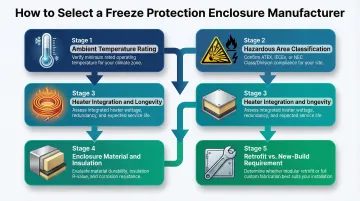
- Key selection criteria: ambient temperature rating, heating integration, insulation conductivity, IP/NEMA certification, and hazardous area classification (ATEX, IECEx, NEC Division/Zone)
- All 10 manufacturers were evaluated on freeze-protection capability, certifications, and fit for oil and gas, petrochemical, and offshore applications
- Terrapin Industrial's patented ThermaGuard design enables retrofittable installation and a 30-year heater cable life without taking instruments offline
- Assess manufacturers on heater longevity, installation cost, and hazard classification compatibility—not just upfront product cost
Overview of Instrument Enclosures in Freeze Protection Applications
An industrial instrument enclosure for freeze protection is a thermally managed housing that keeps field instruments within their operating temperature range during sub-freezing conditions. That means protecting transmitters, analyzers, control valves, and associated tubing from fluid freeze-up, sensor drift, and mechanical damage.
Left unprotected, these failures don't just damage equipment — they trigger process shutdowns.
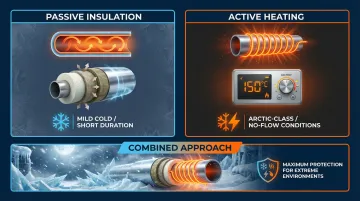
Effective freeze protection relies on two methods: passive insulation (which slows heat loss) and active heating (which maintains temperature). Most demanding applications—oil and gas pipelines, LNG terminals, offshore platforms, and northern chemical plants—require both. Passive insulation alone cannot prevent freezing during extended cold snaps or no-flow conditions, while active heating without insulation wastes energy and creates thermal stress.
With that technical foundation in mind, each manufacturer below was evaluated against the criteria that matter most for freeze protection applications:
- Minimum ambient temperature rating
- Heater integration options
- IP/NEMA sealing ratings
- Hazardous area approvals
- Ease of installation and maintenance in extreme-cold environments
Top 10 Industrial Instrument Enclosure Manufacturers for Freeze Protection
The following manufacturers are evaluated for freeze-protection-specific capabilities—minimum ambient temperature rating, heater integration, IP/NEMA ratings, hazardous area approvals, and installation practicality—not general enclosure features alone.
Terrapin Industrial
Terrapin Industrial is a US-based manufacturer (Richwood, TX) founded by oil and gas field professionals who identified critical inefficiencies in rigid enclosure installation. Their patented ThermaGuard modular enclosure system is designed specifically for industrial instrument freeze protection.
Traditional enclosures require instruments to be taken offline for installation or replacement, creating downtime, schedule delays, and significant labor costs. The ThermaGuard system addresses this directly through retrofittable, piecemeal assembly.
Key differentiators:
- Retrofittable installation: The piecemeal design allows enclosures to be installed around existing instruments without taking them offline, eliminating the 20+ field man-hours typically required per transmitter for traditional systems
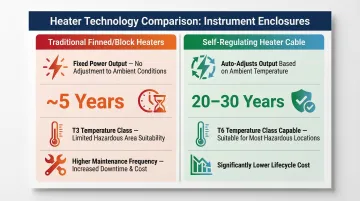
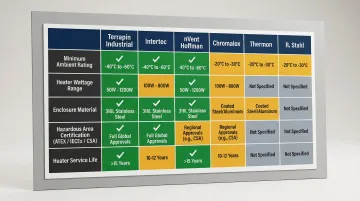
- Patent-pending heated liner: Uses heater cable rated for 30-year life expectancy versus 5 years for finned/block heaters; maintains >75°F/23.9°C interior in -60°F/-51.1°C ambient
- Heat output range: 108W to 720W depending on heater cable selection (3 watts/ft to 20 watts/ft)
- Hazardous area capability: Heated liner can be used in T6 hazardous areas, whereas traditional finned/block heaters are limited to T3 (392°F)
- Cost reduction: Reduces total install cost by 30% and heater installation time by 60% through modular design and pre-engineered entry points
| Key Technical Specs | Certifications / Standards | Best Use Case |
|---|---|---|
| IP66 (Retrofittable), IP65 (Expandable); maintains >75°F in -60°F ambient; 108W–720W heater output; 30-year heater cable life | IP66, IP65; T6 hazardous area rated heated liner | Oil and gas, petrochemical, and offshore facilities requiring freeze protection with minimal installation downtime and classified area compliance |
Intertec Instrumentation
Intertec is a specialized manufacturer known for GRP (glass reinforced polyester) protective enclosures used extensively in arctic and extreme-climate process plant applications, including documented installations on the Alaskan North Slope and in Alberta oil sands.
Their MULTIBOX and DIABOX product lines are engineered for harsh environments where thermal efficiency and corrosion resistance are equally critical.
Key differentiators:
- Superior thermal insulation: GRP's thermal conductivity (~0.2 W/m·K) is roughly 75–250x lower than steel, making it naturally suited for freeze protection
- Composite wall construction: Embedded polyurethane foam insulation eliminates thermal short-cuts from metal components
- Arctic-rated configurations: Suitable down to -60°C with integrated explosion-proof heaters and sealed thermostats
- Heater range: 50W to 400W explosion-proof convection and conduction heaters that integrate with mounting rails
- Field-proven: Deployed on the Alaskan North Slope and Alberta oil sands, with long-service-life performance in sustained sub-zero conditions
| Key Technical Specs | Certifications / Standards | Best Use Case |
|---|---|---|
| Arctic-rated to -60°C; GRP composite walls with PU foam insulation; capacities from 25 to 277 liters | ATEX (Ex e IIC Gb), IECEx, CSA Type 4X | Offshore, Arctic, and severe-climate onshore process plants requiring long-service-life enclosures with minimal maintenance |
nVent Hoffman
nVent Hoffman (Minnesota, USA) is one of the largest global manufacturers of industrial enclosures, with a product line that includes climate-controlled and heated enclosures for outdoor and extreme-temperature applications.
Their Zonex series and hazardous location heater portfolio provide scalable freeze protection across power generation, process, and automation industries.
Key differentiators:
- Comprehensive heater portfolio: Hazardous location heaters ranging from 50W to 800W (approx. 2700 BTU/hr), capable of maintaining temperatures in ambients as low as -60°C
- Zonex enclosure series: ATEX/IECEx certified (Ex e) enclosures available in stainless steel or GRP for hazardous zones
- Integrated controls: Heaters feature integrated or remote thermostats with setpoints typically around 10°C (50°F) or 20°C (68°F)
- Broad catalog support: Wide range of accessories (heaters, gaskets, breathers) enables customized thermal management solutions
| Key Technical Specs | Certifications / Standards | Best Use Case |
|---|---|---|
| Ambient rating to -60°C; 50W–800W heater options; stainless steel and GRP enclosure materials | ATEX, IECEx, UL, cUL; NEMA 4, 4X, 12; IP66 | Power generation, industrial automation, and process industries requiring scalable, catalog-supported freeze protection enclosures |
Pentair Thermal Management (nVent Raychem)
Following Pentair's separation in 2018, the Raychem brand now operates under nVent. Raychem is the recognized leader in self-regulating heat trace technology, offering comprehensive electric heat tracing and freeze protection systems that extend beyond enclosures to system-level design.
Key differentiators:
- Self-regulating heating cable: Invented by Raychem, these cables adjust power output based on local temperature, preventing burnout and extending service life
- Exceptional reliability: Self-regulating cables have a documented service life of 20-30 years, significantly outlasting traditional finned block heaters (~5 years)
- XTVR and BTV cables: Widely used for internal enclosure heating; XTVR rated for continuous exposure up to 150°C
- System-level approach: Combines enclosure, heating cable, controls, and monitoring for comprehensive freeze protection
| Key Technical Specs | Certifications / Standards | Best Use Case |
|---|---|---|
| Self-regulating cables rated for 20-30 year service life; continuous exposure to 150°C; system-level integration | ATEX, IECEx, UL, CSA approvals for hazardous locations | Facilities requiring integrated heat tracing and enclosure systems with centralized freeze protection monitoring |
Chromalox
Chromalox is a US-based industrial heating company (Pittsburgh, PA) with deep experience manufacturing electric heaters and heated enclosures for process industry freeze protection. Their XPMC and AEPS explosion-proof heater lines serve oil and gas, petrochemical, and power generation markets.
Key differentiators:
- XPMC explosion-proof heater: Available in wattages from 100W to 600W with anodized aluminum body and multiple heat sink options
- Temperature ratings: Rated for ambient temperatures down to -40°C with Temperature Codes of T2 or T3
- CSA certified: XPMC and AEPS strip heaters carry CSA certification for Class I, Div 1 & 2 hazardous locations
- Flexible configurations: Multiple heater styles enable customization for specific enclosure sizes and thermal requirements
| Key Technical Specs | Certifications / Standards | Best Use Case |
|---|---|---|
| 100W–600W explosion-proof heaters; ambient rating to -40°C; T2/T3 temperature codes | CSA Class I Div 1 & 2; ATEX (verify current certifications) | Industrial facilities needing certified enclosure heater units as standalone freeze protection components or integrated into existing enclosures |
Thermon
Thermon is a global industrial heating company headquartered in San Marcos, TX, with specialized freeze protection solutions spanning pipelines, process equipment, and instrument enclosures. Their system-engineering approach makes them a strong fit for large-scale oil and gas, chemical, and LNG facilities.
Key differentiators:
- PH fan-forced enclosure heaters: 100W–400W units designed to prevent freezing and condensation in control panels
- HEA Regulator Enclosure heater: Specifically designed for natural gas pipeline regulators, a critical freeze-protection application
- Global certifications: Products carry ATEX, IECEx, UL, FM, and CSA approvals
- Engineering support: System-level engineering approach spans from heat trace to enclosure heating
| Key Technical Specs | Certifications / Standards | Best Use Case |
|---|---|---|
| 100W–400W enclosure heaters; ambient rating to -40°C; specialized regulator heating solutions | ATEX, IECEx, UL, FM, CSA | Large-scale process plants and LNG facilities requiring engineered freeze protection systems with full hazardous area compliance |
Bartec
Bartec is a German manufacturer (Bad Mergentheim) specializing in explosion-protected equipment for hazardous areas, including instrument enclosures rated for use in classified zones with freeze protection capability. Their EJC and EJB flameproof enclosure series and integrated trace heating systems serve global oil and gas and petrochemical markets.
Key differentiators:
- EJC and EJB flameproof enclosures: Rated for Zone 1 and 2, available in aluminum, stainless steel, and polyester
- Extreme cold capability: Enclosures designed for ambients ranging from -40°C to +70°C
- Integrated trace heating: Complete trace heating system (PSB, HSB tapes) and connection kits certified for hazardous areas
- European and Asian market strength: Extensive ATEX and IECEx certifications for gas and dust atmospheres
| Key Technical Specs | Certifications / Standards | Best Use Case |
|---|---|---|
| Ambient rating -40°C to +70°C; aluminum, stainless steel, and polyester construction; integrated trace heating systems | ATEX, IECEx; Zone 1/2 and Division 1/2 classifications | Offshore platforms and classified onshore facilities requiring hazardous area-rated instrument enclosures with freeze protection |
R. Stahl
R. Stahl is a German manufacturer (Waldenburg) renowned for explosion protection expertise and high-quality enclosures for extreme climate applications. Their TEF series enclosure heaters and Ex e enclosures are commonly specified in offshore, LNG, and Arctic process plants where both classified area approval and extreme cold resistance are mandatory.
Key differentiators:
- TEF series arctic heaters: Engineered for operating ranges from -50°C to +50°C
- High power output: TEF9207 series offers 100W to 600W output using self-regulating elements
- Premium materials: Acid-resistant stainless steel (AISI 316L) housing provides superior corrosion resistance
- GRP and stainless steel enclosures: Ex e (increased safety) enclosures fully compatible with heating modules
| Key Technical Specs | Certifications / Standards | Best Use Case |
|---|---|---|
| Ambient rating -50°C to +50°C; 100W–600W self-regulating heaters; 316L stainless steel construction | ATEX (Ex e IIC T3/T4 Gb), IECEx | LNG terminals, offshore, and Arctic-class process facilities requiring full ATEX/IECEx-certified instrument enclosures |
Hammond Manufacturing
Hammond Manufacturing (Guelph, Ontario, Canada) brings over 100 years of experience in electrical enclosures to the North American market. Their outdoor-rated housings deliver practical freeze protection for Canadian and US industrial sites, particularly where hazardous area classification is not required.
Key differentiators:
- NEMA 4/4X outdoor enclosures: Combined with compatible heater accessories, provide practical freeze protection for general industrial use
- North American focus: Strong presence in power, telecommunications, and process industries across Canada and US
- Heater compatibility: FLHTF series heaters with thermostats maintain internal temperatures
- Catalog support: Extensive product catalog and accessories enable standardized solutions
| Key Technical Specs | Certifications / Standards | Best Use Case |
|---|---|---|
| NEMA 4/4X outdoor ratings; compatible heater accessories with thermostats | UL, CSA; NEMA 4, 4X | North American industrial and utility sites requiring reliable, catalog-supported outdoor instrument enclosures for moderate freeze protection needs |
Fibox
Fibox is a Finnish manufacturer (Espoo) of polycarbonate, GRP, and aluminum enclosures with outdoor, chemical-resistant housings suited for instrument protection in cold climates. Their Nordic engineering background shapes a practical, cold-weather-first design approach.
Key differentiators:
- Non-metallic materials: Polycarbonate and GRP enclosures offer significantly better thermal insulation than metal
- PC and CAB P series: Lightweight and corrosion-resistant with IP 66/67 ratings
- Cold-weather ratings: Polycarbonate enclosures rated for continuous use from -40°C to +80°C
- Impact resistance: IK 08/10 impact ratings and UL 94 V0 flammability rating
| Key Technical Specs | Certifications / Standards | Best Use Case |
|---|---|---|
| Ambient rating -40°C to +80°C; polycarbonate and GRP construction; IP 66/67 protection | UL, CE, IEC; IP 66/67; IK 08/10 impact ratings | Chemical processing, water treatment, and industrial facilities requiring corrosion-resistant enclosures with passive freeze protection in moderate cold climates |
How We Chose the Best Manufacturers
Every manufacturer on this list was evaluated against freeze-protection performance criteria specifically—thermal performance, heater reliability, and cold-weather field track record. IP rating alone doesn't tell you whether an enclosure will hold temperature at -40°C, which is why so many buyers end up with underperforming systems.
Primary evaluation criteria:
- Rated to maintain safe internal temperatures in extreme cold (-40°C to -60°C minimum ambient)
- Active heating integration: heater type, wattage range, and thermostat control options
- Insulation material and thermal conductivity (GRP and composite outperform steel by 75–250x)
- IP66 or NEMA 4X sealing minimum for outdoor and offshore use
- ATEX, IECEx, or NEC Division/Zone certification for hazardous area compatibility
Additional factors considered:
- Retrofit capability versus new-build only
- Total installed cost: materials, labor, and downtime combined
- Heater service life (30-year heater cable versus 5-year finned heaters impacts lifecycle cost)
- North American availability, technical support, and lead times
- Documented installations in Arctic, offshore, and extreme-cold environments
Conclusion
Choosing the right freeze protection enclosure manufacturer requires matching your site's ambient temperature extremes, area classification, and maintenance model to the right product—not defaulting to the most familiar brand name. The manufacturers listed above represent a range of proven freeze protection approaches, each with distinct strengths.
When comparing options, weigh these factors alongside upfront product cost:
- Heater longevity — cable-style heaters (30-year life) vs. finned/block heaters (5-year life) affect long-term maintenance budgets
- Retrofittability — enclosures that install around live instruments avoid costly downtime and can cut total installation cost by up to 30%
- Arctic-rated construction — prioritize GRP enclosures and documented field performance in extreme cold for sub-zero environments
- Area classification compatibility — confirm hazardous location ratings (T-class, ATEX, IECEx) match your site requirements
For oil and gas, petrochemical, or offshore facilities that need a modular freeze protection solution, Terrapin Industrial's ThermaGuard system installs in stages around live instruments without taking them offline. Contact their team at (281)-615-1429 to discuss your application.
Frequently Asked Questions
What is the purpose of an instrument enclosure in freeze protection applications?
Instrument enclosures protect field devices (transmitters, analyzers, valves) from sub-freezing temperatures that would cause instrument failure, fluid freeze-up, or inaccurate readings. They use insulation, active heating, or both to maintain a safe interior temperature range.
What temperature rating should I look for in a freeze protection enclosure?
Enclosures should be rated for your site's minimum ambient temperature (often as low as -40°F to -60°F/-40°C to -51°C in northern or arctic locations) and should specify the minimum interior temperature maintained at that ambient—typically above 40°F/4°C for liquid-filled instruments.
What is the difference between a heated and unheated instrument enclosure?
Unheated enclosures rely on insulation alone to slow heat loss, suitable for mild cold climates or low-power instruments that generate their own heat. Heated enclosures incorporate electric heaters—thermostatically controlled—to actively maintain interior temperature in severe or Arctic-class environments.
What certifications are most important for a freeze protection enclosure used in hazardous areas?
For classified areas, look for ATEX and/or IECEx (international) or UL/FM and CSA (North America) hazardous location approvals, along with a temperature class rating (T-class) ensuring the heater surface cannot ignite flammable gases. T6 certification permits use in areas where gases ignite at temperatures above 85°C.
What are the advantages of a modular instrument enclosure over a traditional rigid enclosure?
Modular enclosures can be installed in sections around existing instruments, so instruments stay online throughout the process. This cuts installation time, labor costs, and schedule delays. They also allow individual component replacement without full enclosure removal, lowering long-term maintenance costs.
How long do heaters in instrument enclosures typically last?
Traditional finned or block-style enclosure heaters typically have a service life of approximately 5 years. Modern self-regulating heater cable designs—such as those used in Terrapin Industrial's ThermaGuard liner—are rated for up to 30 years, reducing maintenance frequency and total lifecycle cost.