Introduction
Sensitive field instruments—pressure transmitters, flowmeters, temperature sensors—are the eyes and ears of industrial process control. When freezing temperatures strike, these critical devices can fail or produce dangerously false readings, putting entire operations at risk. According to a joint FERC/NERC investigation, frozen transmitters and sensing lines accounted for 44% of freeze-related generating unit outages during Winter Storm Uri in February 2021. Even more concerning: 81% of these freeze-related outages occurred at temperatures above the units' stated ambient design temperature, revealing widespread failures in winterization preparation.
Heated instrument enclosures are the primary line of defense in winterization systems across oil and gas, petrochemical, power generation, and other process industries. Selecting and deploying them correctly separates reliable uptime from costly shutdowns and catastrophic incidents.
The U.S. Chemical Safety Board has directly linked frozen critical instrumentation to major industrial fires, including a $34.1 million loss at PBF Energy and a $5.8 million incident at Chevron Phillips, both during freeze events.
Key Takeaways
- Frozen instruments cause 44% of freeze-related power outages and multi-million dollar industrial incidents
- Heated enclosures maintain stable internal temperatures using insulated shells, heating elements, and thermostats
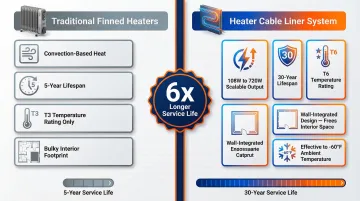
- Modern heater cable systems offer 30-year lifespans versus 5 years for traditional finned heaters
- IP65/IP66 ratings define protection against dust and water; T6 classification ensures hazardous area safety
- Modular retrofittable designs cut installation time by 60% and reduce total costs by 30%
What Is a Heated Instrument Enclosure and Why Does It Matter?
A heated instrument enclosure—also called a protection box or O'Brien box—is an insulated housing, typically metal or hard plastic, that surrounds field instruments in the field. An internal heating element, controlled by a thermostat, maintains a stable internal temperature regardless of extreme ambient conditions.
These enclosures work as part of a broader winterization system—alongside heat tracing on pipes and other freeze-protection measures—to keep the entire measurement and control loop operational through winter and arctic-temperature environments. Specifying the enclosure alone is not enough; it must coordinate with the surrounding thermal protection infrastructure.
The Cost of Inadequate Protection
The consequences of inadequate temperature protection extend far beyond inconvenience. Instrument freeze-up leads to blocked impulse lines, inaccurate readings, false process shutdowns, and permanent sensor damage. Left unaddressed, these failures escalate quickly—triggering false shutdowns, releasing process fluids, and pulling emergency response teams into situations that could have been prevented.
Industrial power interruptions cost approximately $3,253 per hour for average industrial customers, with complex process facilities experiencing far greater losses. A single freeze event can force a complete unit shutdown and create hazardous release conditions that affect the whole facility—not just the instrument that failed.
Multi-Hazard Protection Beyond Freezing
The cost consequences above assume a freeze is the only threat. In practice, a properly sealed enclosure also guards against:
- Wind-driven rain and moisture ingress
- Condensation-related corrosion of sensitive electronics
- Dust and particulate contamination
- Mechanical abuse from field operations
- Temperature extremes in both directions
Understanding IP Protection Ratings
IP (Ingress Protection) ratings define enclosure sealing capability according to IEC 60529 standards. The two most relevant ratings for industrial field installations are IP65 and IP66—and the difference matters more than most specifiers realize.
| Rating | Dust Protection | Water Test Conditions | Typical Use Case |
|---|---|---|---|
| IP65 | Dust-tight | 6.3mm nozzle, 12.5 L/min | General outdoor, rain exposure |
| IP66 | Dust-tight | 12.5mm nozzle, 100 L/min | Washdowns, heavy seas, wind-driven rain |
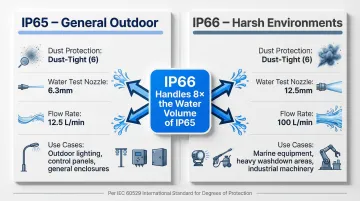
IP66 withstands nearly 8 times the water volume of IP65. For offshore platforms or facilities with regular washdown procedures, specifying IP65 when IP66 is required will lead to water ingress and eventual instrument failure.
Core Components That Make Temperature Control Work
The Insulated Enclosure Shell
The enclosure shell serves as the first layer of defense against heat loss. Insulation material and enclosure surface area directly influence heat retention, which is why matching enclosure size to the instrument package is critical—oversized enclosures waste heating energy, while undersized enclosures create installation challenges and reduce maintenance access.
Modern enclosure shells typically use glass-reinforced polyester (GRP) or ASA plastic with glass reinforcement, both offering durability and thermal efficiency. The insulation itself—whether urethane foam or advanced materials like Pyrogel—determines how much heating energy is required to maintain target temperatures.
Heating Element Technologies
Two primary heating approaches dominate instrument enclosure design, each with distinct advantages:
Traditional Finned or Block-Style Heaters:
- Heat the air inside the enclosure through convection
- Require significant interior space for mounting and airflow
- Typical lifespan of approximately 5 years
- Often rated only for T3 applications (surface temperatures up to 200°C)
Heater Cable Systems: Terrapin Industrial's patent-pending heated enclosure liner takes a different approach. This system integrates heater cable directly into an aluminum liner matrix, with heat output ranging from 108 watts to 720 watts depending on cable selection (3W/ft to 20W/ft). The system is rated for a 30-year life expectancy—six times longer than traditional finned heaters—and can maintain temperatures above 75°F (23.9°C) in environments as cold as -60°F (-51.1°C).
The heater cable approach eliminates bulky finned heaters, freeing interior space for instrument access and maintenance. Heat distributes evenly through the enclosure wall structure rather than from a single interior unit.
The Thermostat's Critical Role
The thermostat cycles the heater on and off to hold internal temperature within the target range, preventing both freeze events and overheating that can damage sensitive electronics. Without proper thermostat control, heaters either run continuously—accelerating wear and premature failure—or allow temperature swings that cause instrument drift and unplanned process downtime.
Hazardous Area Classification Compliance
Because both heater and thermostat are powered electrical components, they must comply with hazardous area classifications in refineries, petrochemical plants, and offshore environments. T-class ratings define the maximum surface temperature equipment can reach under worst-case conditions.
T-Class Ratings Explained:
| T-Class | Max Surface Temp | Safety Application |
|---|---|---|
| T6 | 85°C | Required for gases with very low ignition temperatures (e.g., carbon disulfide) |
| T4 | 135°C | Common requirement for many refinery gases |
| T3 | 200°C | Standard for many general applications |
A T6 rating ensures the equipment surface will not exceed 85°C, making it safe for the most restrictive hazardous environments. Using equipment rated for T3 in a T6 area creates immediate explosion risk—the surface temperature could exceed the ignition temperature of gases present.
Terrapin's heated liner system can be used in T6 areas, providing superior safety compared to traditional finned heaters typically limited to T3 applications.
Full vs. Partial Enclosures: Which Type Do You Need?
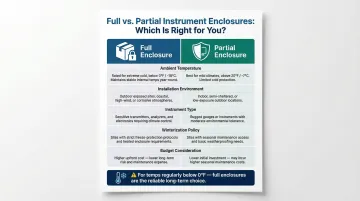
Full Enclosures
Full enclosures surround the entire instrument package—transmitter, manifold, and associated tubing—providing complete protection from drafts, wind-driven rain, dust, and temperature extremes. They're the right choice for harsh outdoor environments where the entire assembly is exposed to the elements.
Terrapin's ThermaGuard Retrofittable and Expandable models offer IP66 and IP65 protection respectively, with external dimensions of 23.58" × 18.75" × 23.61". Both models accommodate single, double, or triple instrument configurations within the same enclosure footprint.
Partial (Wetted Parts) Enclosures
Partial enclosures protect only the process-wetted portions of a transmitter—the sections in direct contact with process fluid—where freeze protection is most critical. These compact solutions cost less and require less installation space, though portions of the instrument remain exposed to ambient conditions.
Rigid heated blankets follow this partial protection approach, delivering targeted thermal protection for specific components like transmitter bodies or manifold assemblies without enclosing the full instrument package.
How to Choose Between the Two
| Factor | Full Enclosure | Partial Enclosure |
|---|---|---|
| Ambient temperature | Sustained sub-freezing conditions | Mild or intermittent cold |
| Installation environment | Fully outdoor, unshielded exposure | Sheltered or semi-protected locations |
| Instrument type | Electronic transmitters with LCD displays | Process-wetted components only |
| Site winterization policy | Facilities mandating full protection on critical instruments | Targeted freeze protection for select components |
| Budget | Higher upfront cost, longer service life | Lower initial cost, may need more frequent replacement |
When in doubt, full enclosures eliminate the guesswork. For facilities in northern climates or offshore environments where temperatures regularly drop below 0°F, the added protection of a sealed enclosure with a heated liner is the more reliable long-term choice.
Key Factors to Consider When Selecting a Heated Instrument Enclosure
Temperature Range Requirements
Engineers must determine the minimum expected ambient temperature for their site and confirm the enclosure/heater combination can maintain the minimum safe instrument operating temperature above that baseline. Terrapin's heated liner specification—maintaining >75°F (23.9°C) in -60°F (-51.1°C) ambient conditions—provides a real-world benchmark for extreme environment applications.
Don't rely on "typical" winter temperatures. The FERC/NERC report found that 81% of freeze failures occurred above stated design temperatures, proving that inadequate design margins create vulnerability.
Heating Capacity and Sizing
Heater wattage required is a function of:
- Temperature differential between required internal temperature and minimum ambient
- Enclosure surface area
- Insulation value (K-factor or R-value)
The fundamental sizing equation is Q = UAΔT, where Q is heat required, U is the overall heat transfer coefficient, A is surface area, and ΔT is temperature differential. A 25-30% safety factor should be added to account for wind chill, leakage, and cold start-up conditions.
Critical guidance: Request engineering support or sizing tools from enclosure suppliers before finalizing specifications. Undersized heaters run continuously without reaching setpoint, leading to premature failure or instrument freezing.
Enclosure Size and Interior Access
The enclosure must physically accommodate the instrument, tubing bundle, and all connections — with enough working room for installation and maintenance. Modern heater cable systems eliminate bulky finned heaters, freeing significant interior volume for instrumentation and connections.
Terrapin's ThermaGuard enclosures offer:
- 21.95" × 17.92" × 23.08" of usable interior space
- Heated liner integrated into the wall structure — not consuming interior volume
- Greater access to instrumentation and process tubing during maintenance
Ingress Protection and Environmental Rating
Match the IP rating to site exposure:
- IP65 for dust-tight and water-jet resistant (general outdoor use)
- IP66 for higher-pressure water ingress protection (offshore, offshore platforms, marine environments, and sites subject to heavy washdown or driving rain)
- IP67/IP68 for temporary or continuous submersion (specialized below-grade or flood-prone installations)