Key Takeaways
- Industrial instrument enclosures protect sensors, transmitters, and control equipment from heat, humidity, chemical exposure, and impact damage common in Alabama's process facilities
- Alabama's process industries require enclosures meeting strict IP, NEMA, and hazardous area certifications
- Selection criteria include IP/NEMA ratings, material compatibility, modular vs. rigid design, and total installation cost
- This list covers 10 manufacturers known for quality, certifications, and reliable service to Alabama facilities
- Options span standard off-the-shelf units to modular retrofittable designs that allow instrument replacement without taking equipment offline
Overview of Industrial Instrument Enclosures in Alabama's Industrial Market
Industrial instrument enclosures are specialized housings designed to protect field instrumentation—transmitters, sensors, analyzers, and control devices—from moisture, extreme temperatures, corrosive chemicals, and mechanical impact. Unlike general electrical cabinets, they're engineered specifically to maintain measurement integrity while keeping personnel away from hazardous components.
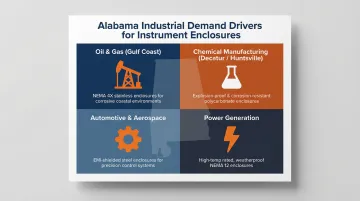
Alabama's industrial landscape drives significant demand for these protective systems. The state's industrial sector consumes 42.1% of total energy, ranking among the top 10 nationally for industrial energy use. Key demand drivers include:
- Oil & Gas (Gulf Coast): Mobile's port and coastal refineries require corrosion-resistant, explosion-proof enclosures
- Chemical Manufacturing (Decatur/Huntsville): Process facilities need enclosures rated for chemical exposure and hazardous atmospheres
- Automotive & Aerospace: Precision manufacturing environments demand reliable environmental protection
- Power Generation: Utilities require enclosures meeting strict safety and environmental standards
That industrial intensity has a direct impact on market growth: the U.S. electrical enclosure market is projected to reach $2.11 billion by 2032. The manufacturers listed below were selected based on product range, certifications, customer base, and track record serving Alabama's industrial sectors.
Top 10 Industrial Instrument Enclosure Manufacturers in Alabama
Each entry below was selected based on product reliability, certification compliance, and demonstrated performance in demanding industrial environments — from Alabama's Gulf Coast chemical plants to inland power generation facilities.
Terrapin Industrial
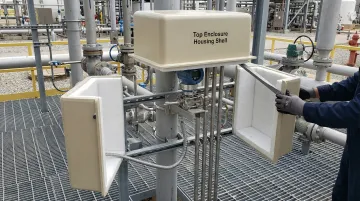
Terrapin Industrial designs and manufactures patented modular and retrofittable instrument enclosures from their Richwood, TX facility, serving oil & gas, petrochemical, power generation, and hazardous area facilities across the United States, including Alabama.
Their patented ThermaGuard modular design allows enclosures to be installed in sections around live instruments — no offline downtime required. That approach cuts total installation time and cost by 30% and heater installation time by 60%. Enclosures carry IP 65 and IP 66 certifications, and the heater cable is rated for a 30-year service life versus 5 years for conventional finned heaters.
| Category | Details |
|---|---|
| Key Features | Patented modular/retrofittable design; quick-connect system; pre-engineered wiring and tube entries; heated liner for use in T6 hazardous areas; self-aligning manifold; individual component replacement capability |
| Certifications | IP 66 (Retrofittable Enclosure); IP 65 (Expandable Enclosure); heated liner rated for T6 hazardous area use |
| Best For | Oil & gas, petrochemical, chemical manufacturing, power generation, and any facility requiring instrument enclosure replacement without taking instruments offline |
nVent Hoffman
nVent Hoffman is a global leader in enclosure solutions with a significant U.S. manufacturing footprint. Headquartered in St. Louis Park, Minnesota, the company offers an extensive portfolio of metallic and non-metallic enclosures suitable for Alabama's diverse industrial needs.
Key differentiators include a comprehensive product range spanning mild steel, stainless steel (304L and 316L), fiberglass, and polycarbonate enclosures. Their Zonex enclosure line carries ATEX and IECEx certifications for Zone 1 and Zone 2 applications and is suitable for Division 1 areas. The company maintains strong distribution reach into Alabama industrial markets.
| Category | Details |
|---|---|
| Key Features | Materials include mild steel, 304L/316L stainless steel, fiberglass, and polycarbonate; Zonex hazardous location line; modular design options; extensive customization capabilities |
| Certifications | NEMA Type 4, 4X, 12; IP66; ATEX and IECEx (Zonex line); UL listings; Division 1 rated options |
| Best For | Petroleum, chemical processing, water/wastewater treatment, pulp and paper, marine environments, and facilities requiring corrosion-resistant solutions |
Rittal Corporation
Rittal combines German engineering precision with a strong U.S. manufacturing presence, operating a facility in Urbana, Ohio. The company is one of the world's largest enclosure manufacturers, known for modular system designs and integrated climate control solutions.
Rittal's differentiators include modular enclosure systems allowing flexible configuration, integrated cooling solutions to protect sensitive instrumentation, and digital engineering tools like EPLAN for simplified, standardized design. Their products serve oil & gas refineries, automotive manufacturing, and power generation facilities throughout the southeastern U.S.
| Category | Details |
|---|---|
| Key Features | Modular system architecture; integrated climate control and cooling; digital engineering integration (EPLAN); extensive accessory ecosystem; wall-mount and free-standing options |
| Certifications | NEMA Type 3R, 4, 4X; various IP ratings; UL listings; compliance with international standards |
| Best For | Oil & gas refineries, automotive manufacturing, power generation, and applications requiring integrated thermal management |
Hammond Manufacturing
Hammond Manufacturing has served North American industry since 1917, maintaining primary manufacturing in Guelph, Ontario, with supporting capabilities in the USA. The company is known for its extensive range of standard and modified enclosures.
Hammond's strengths include comprehensive material options—powder-painted carbon steel, stainless steel, aluminum, and die-cast aluminum—plus extensive modification services to tailor off-the-shelf products to specific needs. Their Eclipse Series and other product lines carry NEMA 3R, 4, 4X, 12, and 13 ratings plus IP66 protection.
| Category | Details |
|---|---|
| Key Features | Wide material selection (steel, stainless, aluminum, die-cast); extensive modification services; large standard product catalog; rapid customization capabilities |
| Certifications | NEMA 3R, 4, 4X, 12, 13; IP66; UL listings; CSA certifications |
| Best For | General industrial applications, food & beverage, outdoor installations, and facilities requiring customized standard enclosures |
Fibox Enclosures
Fibox pioneered the first modular polycarbonate enclosure in 1966 and maintains a U.S. presence in Glen Burnie, MD. The Finnish company specializes in non-metallic enclosures offering lightweight, corrosion-resistant solutions ideal for harsh chemical environments.
Fibox's differentiators center on material innovation: polycarbonate (PC), ABS, and GRP (fiberglass) construction provides superior corrosion resistance compared to sheet steel. Products feature IP65, IP66, and IP67 ingress protection plus high impact resistance ratings (IK07-IK10), making them suitable for Alabama's coastal and chemical processing facilities.
| Category | Details |
|---|---|
| Key Features | Non-metallic construction (polycarbonate, ABS, GRP); superior corrosion resistance; lightweight design; high impact ratings (IK07-IK10); transparent cover options |
| Certifications | IP65, IP66, IP67; UL listings; various international certifications |
| Best For | Chemical processing, wastewater treatment, coastal/marine environments, food & beverage, and applications with aggressive chemical exposure |
Stahlin Enclosures (Allied Moulded Products)
Stahlin has pioneered fiberglass electrical enclosures since the late 1940s and is now part of Allied Moulded Products. The company manufactures in the USA and specializes in durable protection for outdoor and corrosive applications.
The company's key differentiator is its proprietary SolarGuard® formulation, which provides superior UV resistance and chemical protection. Enclosures are constructed from fiberglass reinforced polyester and rated NEMA 4X / IP66 with UL listings. This makes them ideal for Alabama's Gulf Coast facilities facing salt spray and high humidity.
| Category | Details |
|---|---|
| Key Features | Fiberglass reinforced polyester construction; SolarGuard® UV/chemical protection; lightweight yet durable; non-corrosive; window and viewing options available |
| Certifications | NEMA 4X; IP66; UL listed; meets various industry standards for corrosive environments |
| Best For | Coastal installations, chemical plants, wastewater facilities, outdoor applications, and environments requiring high corrosion resistance |
Pepperl+Fuchs
Pepperl+Fuchs, headquartered in Mannheim, Germany, with a strong U.S. presence, is a premier choice for hazardous area protection. The company specializes in certified solutions for explosive atmospheres common in Alabama's oil, gas, and chemical sectors.
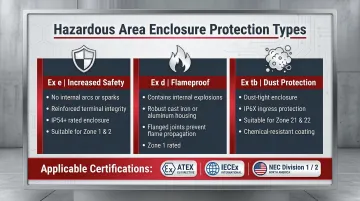
Key differentiators include terminal and junction boxes with protection types including Ex e (increased safety), Ex d (flameproof), and Ex tb (dust protection). Materials include glass fiber reinforced polyester (GRP), brushed stainless steel, and copper-free aluminum. Products carry comprehensive certifications including ATEX, IECEx, NEC Class I/II Division 1/2, and UL listings.
| Category | Details |
|---|---|
| Key Features | Multiple explosion protection types (Ex e, Ex d, Ex tb); GRP, stainless steel, and aluminum options; terminal and junction box configurations; field-proven designs |
| Certifications | ATEX; IECEx; NEC Class I/II Division 1/2; UL; FM; comprehensive international hazardous area certifications |
| Best For | Oil & gas facilities, chemical plants, offshore platforms, refineries, and any Division 1/2 or Zone 1/2 classified areas |
AutomationDirect
AutomationDirect, based in Cumming, Georgia, provides cost-effective and readily available enclosure solutions throughout the southeastern U.S. including Alabama. The company is a major industrial distributor with strong regional presence.
AutomationDirect distributes major brands including AttaBox, Hammond, Integra, Stahlin, Fibox, and Wiegmann, offering wall-mount, freestanding, and instrument enclosures in carbon steel, stainless steel, fiberglass, and polycarbonate. Products cover the full spectrum of NEMA 1, 3, 3R, 4, 4X, 6P, 12, and 13 ratings. The company is ideal for facilities seeking competitive pricing and fast shipping.
| Category | Details |
|---|---|
| Key Features | Multi-brand distribution; online ordering with fast shipping; competitive pricing; extensive inventory; technical support; wide variety of sizes and materials |
| Certifications | NEMA 1, 3, 3R, 4, 4X, 6P, 12, 13 (varies by brand); UL listings; various IP ratings |
| Best For | Standard industrial applications, facilities requiring quick delivery, budget-conscious projects, and integrators needing variety |
C & I Enclosures
C & I Enclosures, located in Bessemer, Alabama, offers a distinct local advantage for Alabama facilities requiring rapid, custom solutions. This in-state manufacturer specializes in UL-certified electrical enclosures with a focus on speed and customization.
The company is known for rapid production times averaging 4-7 days and fabricates enclosures in galvanized steel, powder-coated steel, aluminum, and 304/316 stainless steel. C & I provides a critical resource for Alabama industries needing custom NEMA 4 or 4X instrument protection without the long lead times of larger global suppliers.
| Category | Details |
|---|---|
| Key Features | Local Alabama fabrication; rapid 4-7 day turnaround; custom design and fabrication; galvanized, powder-coated, aluminum, and stainless steel options |
| Certifications | UL-certified; NEMA 4 and 4X ratings; custom certifications available |
| Best For | Alabama facilities requiring custom solutions, rapid turnaround projects, local support, and site-specific designs |
Bison ProFab
Bison ProFab, based in Magnolia, Texas, is a custom manufacturer serving the broader Gulf Coast region including Alabama. The company specializes in high-quality NEMA-rated metal enclosures, with 95% of their work focused on custom fabrication rather than off-the-shelf products.
Bison ProFab manufactures using aluminum, carbon steel, and stainless steel, providing custom NEMA 1, 3R, 4, and 4X solutions. While Texas-based, their Gulf Coast focus makes them a viable option for specialized Alabama projects requiring custom engineering and fabrication.
| Category | Details |
|---|---|
| Key Features | 95% custom fabrication focus; aluminum, carbon steel, and stainless steel options; engineering support; project-specific designs; Gulf Coast regional service |
| Certifications | NEMA 1, 3R, 4, 4X ratings; custom certifications available; compliance with industry standards |
| Best For | Specialized projects, custom configurations, facilities requiring engineered solutions, and applications where standard products don't fit |
Larson Electronics
Larson Electronics is a Texas-based manufacturer and supplier of industrial electrical equipment including enclosures, with distribution reach into Alabama and the broader Gulf Coast industrial corridor. The company specializes in hazardous location equipment.
Key differentiators include hazardous location rated products, customization options, and proven service to oil & gas and petrochemical facilities in the region. Larson offers explosion-proof and purged/pressurized enclosures suitable for Class I and Class II locations.
| Category | Details |
|---|---|
| Key Features | Hazardous location specialization; explosion-proof and purged enclosures; customization capabilities; quick-ship options; Gulf Coast distribution network |
| Certifications | NEMA 4, 4X, 7, 9; various IP ratings; NEC Class I/II Division 1/2; UL/FM listings |
| Best For | Oil & gas facilities, petrochemical plants, refineries, hazardous location applications, and facilities requiring explosion-proof protection |
How We Chose the Best Industrial Instrument Enclosure Manufacturers
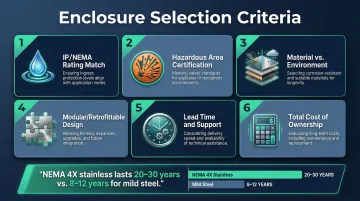
Many buyers make the critical mistake of selecting enclosures based solely on upfront unit price, overlooking total installed cost, certification compliance, and long-term maintenance implications. Unplanned downtime in industrial environments costs between $36,000 and $2.3 million per hour depending on the industry, with approximately 42% of incidents attributed to equipment failure.
Key selection factors used:
- Matches IP/NEMA protection level to environmental hazards — IP65 minimum for outdoor, IP66 for washdown, NEMA 4X for corrosive environments
- Verifies hazardous area certifications: ATEX, IECEx, NEC Division 1/2, and Zone classifications where applicable
- Evaluates material against environment — carbon steel for indoor/dry, 316 stainless for marine/chloride exposure, fiberglass for chemical contact
- Assesses modular and retrofittable designs, which can reduce total project cost by 30% and eliminate offline instrument replacement
- Reviews lead times, technical support depth, and regional service availability
- Calculates total cost of ownership — a NEMA 4X stainless enclosure typically costs 85% more upfront than mild steel NEMA 4, but lasts 20–30 years versus 8–12 years in corrosive service
Traditional rigid enclosures require instruments to go offline for replacement — often 20+ man-hours per unit. That's why retrofittable designs, like Terrapin Industrial's modular enclosures, factor into this evaluation alongside certifications and material specs.
Conclusion
Alabama's industrial facilities have access to a strong mix of global manufacturers, national distributors, and specialized suppliers when sourcing instrument enclosures. The right choice depends on specific application requirements, environmental classification, and installation constraints. Key selection factors include:
- NEMA rating: NEMA 4 covers general outdoor use; NEMA 4X is required in corrosive Gulf Coast environments
- Hazardous area classification: Division 1 areas require explosion-proof or purged enclosure designs, not standard weather-resistant housings
- Material grade: Fiberglass and 316 stainless steel outperform carbon steel in coastal or chemical-exposure environments
- Thermal performance: Heated liners or finned heaters are necessary where ambient temperatures fall below instrument operating ranges
Evaluating beyond product specifications matters. Total cost of ownership, installation flexibility, and long-term maintenance support are often deciding factors — specifying the right material grade from the start typically avoids early replacement and unplanned downtime costs.
For facilities where taking instruments offline during enclosure installation or replacement is not an option, Terrapin Industrial's ThermaGuard modular enclosures are built specifically for that constraint. Their retrofittable design allows enclosures to be installed around live instruments in stages — no process interruption, no offsite integration. Total installation costs run 30% lower than traditional rigid enclosure approaches. Contact Terrapin at (281)-615-1429 or (210)-219-2821 to discuss your application.
Frequently Asked Questions
What is an industrial instrument enclosure used for?
Industrial instrument enclosures protect field instruments such as transmitters, sensors, and analyzers from environmental hazards including moisture, dust, extreme temperatures, corrosive chemicals, and mechanical impact. They ensure accurate measurement and equipment longevity in demanding industrial settings.
What IP rating is recommended for outdoor industrial instrument enclosures?
IP65 is the minimum recommended for outdoor use, providing dust-tight protection and defense against water jets. IP66 offers higher protection against powerful water jets and is preferred for high-pressure washdown areas or heavy seas. Choose based on the specific washdown pressures and environmental exposure at your site.
What is the difference between a modular and a rigid instrument enclosure?
Rigid enclosures are fixed single-piece housings requiring instruments to be taken offline during installation or replacement. Modular enclosures—such as Terrapin Industrial's ThermaGuard system—are assembled in sections around existing instruments, eliminating downtime and reducing installation complexity by up to 30%.
How do I select the right instrument enclosure for a hazardous area?
Start by identifying the hazardous location classification (NEC Division 1/2 or Zone 0/1/2). Match the enclosure certification — explosion-proof, purged/pressurized, or increased safety — to that classification, and confirm third-party documentation compliance. The temperature class (T-rating) must also align with the ignition temperature of substances present.
What materials are commonly used in industrial instrument enclosures?
Four main options exist:
- Carbon steel — cost-effective for standard indoor environments
- Stainless steel — corrosion-resistant for food, chemical, and offshore applications
- Fiberglass — lightweight with high corrosion resistance
- Polycarbonate — non-metallic, suited for moderate environments
Material selection should be driven by chemical exposure, temperature range, and environmental classification.
Can an instrument enclosure be replaced without shutting down the instrument?
Traditional rigid enclosures typically require the instrument to be taken offline for replacement. However, retrofittable modular designs—like Terrapin Industrial's patented ThermaGuard system—allow the enclosure to be removed and replaced around a live instrument, without process interruptions.